Why Don’t Muslims Eat Pork? The Quranic, Spiritual, and Health Reasons Explained
If you have ever shared a meal with a Muslim friend or coworker and noticed pork missing from the table, you have probably wondered about the reason behind it. It is one of the most common questions people ask about Islam, and the short answer is simple: the Quran directly forbids it.
But the full picture involves scripture, spiritual purity, and even modern health research, and understanding all three gives a much clearer answer than a single verse ever could. This guide walks through exactly why do muslims not eat pork, what the Quran and hadith say, what science has found, and how this practice compares to similar dietary rules in Judaism and Christianity.
Do Muslims Eat Pork?
No. Pork, along with anything derived from pigs such as bacon, ham, lard, and pork gelatin, is classified as haram, meaning forbidden, in Islamic dietary law. This is not a cultural preference or a regional custom. It applies to Muslims everywhere in the world, regardless of country, sect, or level of religious practice.
Some Muslims may be less strict about other dietary details, but the pork prohibition is treated as one of the clearest and most universally observed rules in the faith. That said, Islamic law does allow exceptions in genuine emergencies, which we will cover further down.
Why Can’t Muslims Eat Pork According to the Quran
The prohibition comes straight from the text of the Quran, repeated in four separate chapters. This repetition is itself significant in Islamic scholarship, since it shows the ruling is not a one time mention but a consistent command.
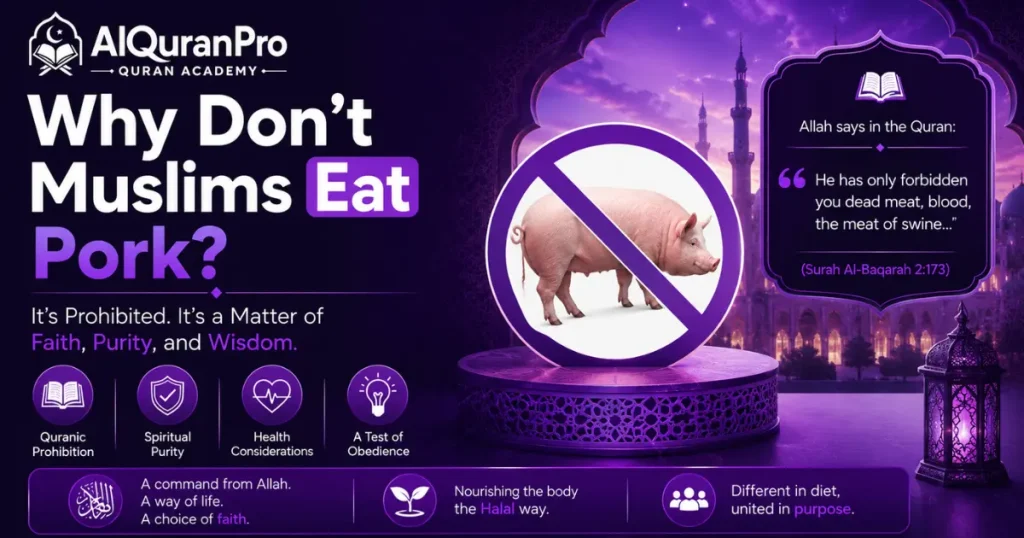
The clearest example is Surah Al Baqarah, chapter 2, verse 173, which states that Allah has forbidden carrion, blood, the flesh of swine, and anything slaughtered while invoking a name other than His. You can read the full verse and its translation directly on Quran.com, which offers word for word Arabic text alongside multiple English translations. The same instruction appears again in Surah Al Ma’idah (5:3), Surah Al An’am (6:145), and Surah An Nahl (16:115), each time grouping pork with carrion and blood as impure substances.
For readers who want to study the verse in context rather than as an isolated quote, our page on the Quran translation in English is a good place to start, since understanding a single ruling is much easier once you can see how it fits into the surrounding passage.
Why Is Pig Haram in Islam
The Quran does not spend much time explaining its own reasoning, and that is intentional. In Islamic theology, obedience to a divine command does not require full human understanding of the wisdom behind it. Still, scholars over the centuries have offered explanations, and they generally fall into two categories.
The first is the concept of tahara, or ritual purity. Pork is classified as najas, meaning inherently impure, which places it in the same category as carrion and blood rather than simply being an unhealthy food choice. Avoiding it is treated as an act of worship and submission, similar in spirit to prayer or fasting, rather than a dietary preference based on taste or convenience.
The second is that abstaining from pork builds a habit of self restraint. Islamic teaching frames food discipline as training for the will, the same underlying idea behind fasting during Ramadan. If you want to explore how these kinds of obligations connect to the broader structure of Islamic belief and practice, our overview of Islamic studies online courses covers the foundational concepts in more depth.
Why Is Eating Pork Haram: The Health Angle
Alongside the spiritual reasoning, many scholars and writers point to health concerns that align with the prohibition, even though the Quran itself does not frame the rule primarily as a medical instruction.
Pigs are omnivorous and, especially in less controlled farming conditions, will eat almost anything, including waste. Undercooked or improperly handled pork has historically been linked to trichinosis, a parasitic infection caused by Trichinella roundworms. The U.S. Centers for Disease Control and Prevention explains that trichinellosis develops after eating raw or undercooked meat containing this parasite, and that pork was historically the leading source of infection before modern inspection standards reduced the risk in commercial farming. You can read the full breakdown on the CDC’s trichinellosis page.
Research published through the National Institutes of Health also notes that trichinosis remains a public health concern in regions where undercooked pork or wild game is still commonly eaten, and that the parasite can cause symptoms ranging from mild digestive upset to serious muscle and cardiac complications in severe cases. That overview is available through the NIH’s NCBI Bookshelf. While modern farming and cooking practices have reduced these risks considerably, many Muslims see this scientific backing as a confirmation of wisdom that was revealed 1,400 years before microbiology existed.
Pork and Other Religions: A Shared Restriction
One detail that surprises a lot of people is that this restriction is not unique to Islam. Jewish dietary law, or kashrut, also forbids pork, and the origin of that rule appears in the Torah, in the same body of scripture that Christians know as the Old Testament. Leviticus chapter 11 lists the pig specifically as unclean because it does not chew the cud, even though it has a split hoof. You can read the original passage on BibleHub, which presents the verse across several translations.
This overlap is part of why many Muslims bring up the comparison when discussing the topic with Jewish or Christian friends. Two major world religions, developed in the same region and drawing on related prophetic traditions, arrived at the same dietary conclusion independently reinforced across their scriptures. It is a useful reminder that Islamic dietary law did not appear in isolation from other Abrahamic traditions, a theme our article on cats in Islam also touches on when it comes to how Islamic teaching approaches animals more broadly.
What Happens If a Muslim Eats Pork by Accident?
This question comes up often, especially among Muslims living in countries where pork appears in unexpected places, from broth and gelatin to shared cooking surfaces at restaurants.
Islamic teaching draws a clear line between intentional and unintentional actions. A well known hadith recorded in Sunan Ibn Majah states that Allah has forgiven the Muslim community for mistakes, forgetfulness, and actions taken under genuine compulsion. You can read the full hadith with its chain of narration on Sunnah.com. Based on this principle, a Muslim who eats pork without knowing what it was, or who consumes it because no other food was available in a genuine survival situation, is not held sinful for that act.
The Quran itself makes this exception explicit in the same verse that establishes the prohibition. Surah Al Baqarah 2:173 states that a person compelled by necessity, without desiring the forbidden food or exceeding what is needed to survive, incurs no sin. The general recommendation once someone realizes they have eaten pork unknowingly is simply to stop eating it immediately and move on, without guilt or the need for any special ritual. For readers who want to understand how Islamic teaching more broadly distinguishes between minor slips and serious wrongdoing, our guide to major sins in Islam breaks down that framework in detail.
What Is the Punishment for Eating Pork in Islam?
There is no worldly legal punishment for eating pork in Islam, and no court or authority is meant to enforce this rule through physical consequences. The matter is considered a private one between an individual and Allah, similar to skipping a prayer or breaking a fast without a valid reason.
Deliberately and knowingly eating pork without necessity is considered a sin, since it is direct disobedience to a clear divine command. Islamic theology teaches that sins affect a person spiritually rather than triggering an earthly penalty, and that sincere repentance, known as tawbah, restores a person’s standing before Allah. This connects to the broader Islamic understanding of accountability, where actions in this life are ultimately weighed in the afterlife rather than punished immediately here. Our article on Jannah in Islam explains how obedience, sin, and repentance factor into that final accounting.
Why Cant Muslims Eat Pork if Allah Created Pigs?
This is one of the most common follow up questions, and it deserves a direct answer. Islamic scholars point out that not everything created by Allah is meant for human consumption. Poisonous plants and venomous animals exist in nature too, without anyone assuming they were created to be eaten. Pigs serve ecological purposes as scavengers, but that role does not determine what is permissible for humans to consume.
Islamic teaching frames the prohibition, like other tests of obedience such as avoiding alcohol or interest based transactions, as a chance for believers to choose divine guidance over personal desire, even when the full reasoning is not immediately obvious.
The Bottom Line
Muslims avoid pork because the Quran commands it directly, repeating the prohibition across four separate chapters and pairing it with concepts of purity and obedience rather than simple taste preference. Centuries of religious scholarship point to spiritual purity and disciplined self restraint as the primary reasons, while modern health research on parasites like Trichinella offers a secondary layer of support that many find reinforces the wisdom of the original command.
The rule is firm, but Islamic law also builds in genuine compassion for mistakes, forgetfulness, and real emergencies, which reflects a broader theme found throughout the Quran: clear boundaries paired with mercy for those who fall short unintentionally.