Jannah in Islam: Meaning, Description and the Path to Paradise
Every Muslim grows up hearing the word Jannah. It is mentioned in daily duas, whispered at funerals and repeated in Friday sermons. Yet many people, including born Muslims, never sit down and ask what this eternal home really is beyond the simple idea of “heaven.” This guide answers that question in full. You will learn its Arabic origin, what the Quran and authentic hadith say about its levels and gates, what life there will actually feel like and the concrete deeds that bring a believer closer to it. Whether you are new to Islam, teaching your children or simply curious about jannat islam, this article gives you a complete and reliable picture grounded in scripture.
What Is Jannah in Islam?
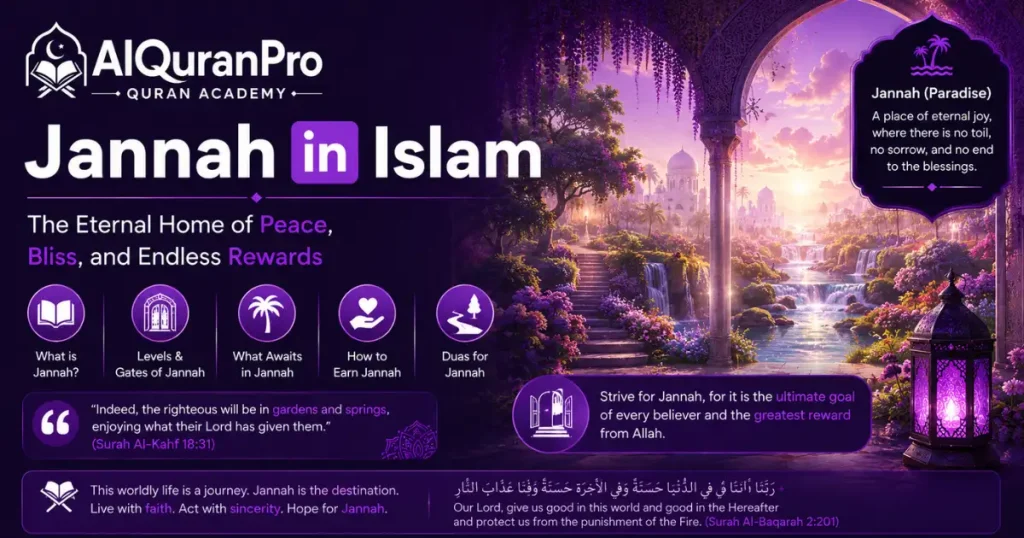
Simply put, Jannah is the eternal home that Allah has promised to those who believe in Him and live righteously. It is not a metaphor or a state of mind. According to the Quran and the sayings of Prophet Muhammad (peace be upon him), Jannah is a real, physical and spiritual realm that awaits every soul after the Day of Judgment.
The Quran describes it in Surah Al Baqarah:
“And give good tidings to those who believe and do righteous deeds, that for them will be gardens beneath which rivers flow.” (Quran 2:25)
This single verse captures the heart of the concept. Jannah is a reward, not a birthright. It is earned through faith paired with action, and it is described again and again throughout the Quran as a garden filled with rivers, shade, fruit and comfort that human beings cannot fully picture with their limited experience of the world.
Jannah Meaning and the Origin of the Word
The word Jannah comes from the Arabic root “j n n,” which relates to concealment or something hidden from plain sight. This is fitting, since Jannah is a realm hidden from human eyes until the afterlife begins. In everyday Arabic, the same root gives us the word for garden, because a garden filled with trees is often shaded and partly hidden from view.
So when someone asks what does jannah mean, the short answer is simply “garden,” but the fuller answer is a hidden garden of everlasting bliss prepared by Allah as the ultimate reward. The Prophet Muhammad (peace be upon him) once described it in a hadith recorded by Imam Muslim:
“Allah says: I have prepared for My righteous slaves what no eye has seen, no ear has heard and no human heart has ever imagined.”
That single sentence explains why no article, painting or description can ever do Jannah full justice. Every detail we read in the Quran or hadith is simply a glimpse, given in language humans can relate to, of something far greater than words can capture.
Heaven in Islam Versus Jahannam
In everyday English, people use the word heaven loosely to describe comfort, happiness or a pleasant place. In Islamic teaching, this paradise refers specifically to Jannah, and it stands in direct contrast to Jahannam, the Islamic concept of hell. Understanding both side by side makes the picture of the afterlife much clearer.
|
Aspect |
Jannah (Paradise) |
Jahannam (Hellfire) |
|
Meaning |
Garden, eternal bliss |
Blazing fire, punishment |
|
Who enters |
Believers who did good deeds and were forgiven |
Those who rejected faith or persisted in major sin |
|
Environment |
Gardens, rivers, shade, palaces |
Scorching fire, boiling water, chains |
|
Emotional state |
Peace, joy, no sorrow or fear |
Regret, distress, despair |
|
Duration |
Eternal for believers |
Eternal for disbelievers; temporary purification for some sinning believers |
This comparison is why Muslims are taught to live with both hope and awareness. Striving for Jannah is not only about seeking reward. It is also about consciously avoiding the path that leads away from it, which is why the Quran frequently mentions both destinations in the same breath.
The Levels of Jannah
One detail that often surprises new learners is that Jannah is not a single flat destination. It has multiple levels, and a person’s position depends on the strength of their faith and the quality of their deeds. The Prophet Muhammad (peace be upon him) described this clearly in an authentic hadith recorded in Sunnah.com’s collection of Jami at Tirmidhi:
“In Paradise there are a hundred levels, and the space between each level is like the space between the heaven and the earth. Al Firdaus is its highest level, and from it the four rivers of Paradise flow. So when you ask Allah, ask Him for Al Firdaus.”
Some of the named levels commonly discussed by scholars include:
|
Level Name |
Meaning |
Notable Feature |
|
Jannat al Firdaus |
Highest Garden |
Closest to the Throne of Allah |
|
Jannat al Adn |
Garden of Eternal Residence |
Promised to the sincerely faithful |
|
Jannat al Naim |
Garden of Bliss |
Filled with delight and comfort |
|
Jannat al Mawa |
Garden of Refuge |
A safe shelter for the righteous |
|
Dar al Salam |
Home of Peace |
Complete safety and serenity |
This structure explains a habit many Muslims carry throughout life: instead of simply asking Allah for “Jannah” in their prayers, they specifically ask for Al Firdaus, following the Prophet’s own guidance.
The Gates of Jannah
Alongside its levels, Jannah is also described as having eight gates, each associated with a category of good deeds. A person may be called through the gate connected to their strongest act of worship. Abu Huraira reported that the Prophet said whoever performs ablution properly and testifies to the oneness of Allah will have all eight gates of Paradise opened for them to choose from.
|
Gate |
Associated With |
|
Bab as Salah |
Those consistent in prayer |
|
Bab as Sadaqah |
Those generous in charity |
|
Bab ar Rayyan |
Those who fasted sincerely |
|
Bab al Jihad |
Those who strove in Allah’s cause |
|
Bab al Hajj |
Those who performed pilgrimage |
|
Bab al Kazimeen al Ghaiz |
Those who controlled anger and forgave |
|
Bab al Iman |
Those firm in belief |
|
Bab az Zikr |
Those devoted to remembrance of Allah |
Scholars note that a believer who excels in several of these areas may be invited through more than one gate at once, which is considered a special honor on the Day of Judgment.
What Does Jannah Look Like? Description in the Quran and Hadith
Naturally, one of the most common questions people search for is how paradise actually appears. While a full description of Jannah is beyond human imagination, the Quran and hadith give us vivid, recurring images that help the mind form a picture.
- Flowing rivers. Surah Muhammad describes rivers of pure water, milk that never sours, wine that does not intoxicate and clear honey, all flowing through the gardens (Quran 47:15). You can read the full verse directly on Quran.com’s translation of Surah Muhammad.
- Gardens and shade. Jannah is repeatedly called “gardens beneath which rivers flow,” with abundant trees, shade and fruit available in any quantity the soul desires.
- Palaces and fine garments. Those who reach the higher levels are described as wearing silk garments and gold jewelry, and residing in palaces built from precious materials, symbolizing the honor Allah bestows on His most devoted servants.
- Perfect companionship. Families will be reunited across generations if their faith matched, and believers will enjoy the company of prophets, the truthful and the righteous, an image the Quran presents in Surah An Nisa (4:69).
- Freedom from sorrow. Perhaps the most emotionally powerful promise in all of Islamic scripture is that Allah will remove every trace of resentment, jealousy, sadness and fatigue from the hearts of its people (Quran 7:43, 15:47).
Together these details form a full, sensory picture. It is a place of physical delight, but the Quran is careful to remind us repeatedly that its true joy is spiritual: closeness to Allah and lasting peace of heart.
Life in Jannah: What Muslims Believe Awaits Them
Beyond the physical descriptions, Islamic teaching paints a picture of daily existence in Jannah that is fundamentally different from life on earth.
There is no aging or illness. Every resident is described as being restored to their prime, free from the wear of time. There is no hunger or thirst that goes unmet, and no boredom, since every desire is fulfilled the moment it is felt. There is no death, since Jannah is a truly eternal home, not a temporary reward.
The greatest blessing mentioned in authentic hadith is the ability of believers to see Allah directly. The Prophet Muhammad (peace be upon him) said that people will see their Lord as clearly as they see the full moon on a clear night, without any difficulty or harm (Bukhari and Muslim). Scholars regard this moment, often called the vision of Allah, as the single greatest joy a soul can ever experience, surpassing even the rivers, palaces and companionship mentioned earlier.
What Do Muslims Call Heaven and How Is It Different From Other Faiths
A common question from people exploring Islam concerns the exact term used for paradise, and whether it matches the concept found in other religions. Muslims specifically use the word Jannah, and while it shares some general themes with the Christian idea of heaven, such as eternal life and closeness to God, the Islamic description is far more detailed and structured, with named levels, specific gates and clearly defined criteria for entry tied to both belief and deeds. You can compare perspectives further through resources like Wikipedia’s overview of Jannah, which summarizes how the concept developed across classical Islamic scholarship.
How to Enter Jannah in Islam
Understanding Jannah is only half the purpose of learning about it. The Quran and Sunnah are equally clear about the path that leads there. Below are the core steps every Muslim is encouraged to build their life around.
1. Establish strong faith and consistent prayer. Salah, or the daily prayer, is described repeatedly in hadith as one of the most direct routes to Paradise. The Prophet said that whoever performs ablution well and prays two units of prayer with full presence of heart will have Paradise made obligatory for them.
2. Give charity sincerely. Sadaqah, even in small amounts given consistently, is tied directly to one of the eight gates of Jannah.
3. Avoid major sins and seek repentance. Since Jannah and Jahannam are opposite outcomes, staying away from major sins in Islam and turning back to Allah in sincere repentance is essential. No person is expected to be perfect, but persistence in sin without repentance is what the Quran warns against most.
4. Recite and reflect on the Quran. The Prophet taught that a person who memorizes the Quran will be told on the Day of Judgment to “recite and ascend,” rising one level in Jannah for every verse recited. Programs that support Quran memorization help build this habit gradually rather than all at once.
5. Understand what you recite. Reading the Quran with proper English translation allows a believer to connect emotionally and intellectually with the verses about Jannah rather than reciting them without reflection.
6. Make sincere dua. The Prophet taught that whoever asks Allah for Jannah three times, Jannah itself will say “O Allah, admit him into me.” Learning the structure and etiquette of Islamic supplication helps believers ask with the sincerity that these hadith describe.
7. Maintain good character. Patience, honesty, controlling anger and treating others with kindness are mentioned throughout the Quran as qualities of those destined for Paradise, often placed on equal footing with ritual worship.
None of these steps guarantee salvation on their own, and Islamic teaching is clear that ultimate mercy belongs to Allah alone. However, together they represent the path the Quran and Sunnah describe as leading toward Jannah, built on sincerity, consistency and genuine effort rather than isolated acts.
Final Thoughts
Jannah is far more than a distant idea mentioned in passing. It is described in the Quran and the words of the Prophet Muhammad (peace be upon him) in enough detail to shape how a believer prays, behaves and views the purpose of life itself. From its origin as a word meaning hidden garden, to its structure of levels and gates, to the promise of a heart finally free from sorrow, Jannah represents the ultimate goal that Islamic teaching centers around. Learning about it is not only an act of curiosity.
It is meant to be a source of motivation, encouraging reflection, sincere worship and steady effort toward the life Allah has promised to those who strive for it. For further study on the primary sources referenced in this guide, you can explore the hadith collection on Sunnah.com and classical explanations available through Al Islam’s translated works on the afterlife, as well as scholarly guidance available at AboutIslam’s Ask the Scholar archive.
Frequently Asked Questions
What exactly is Jannah?
Jannah is the eternal paradise that Allah promises to believers who live righteously. It is described in the Quran as gardens filled with rivers, peace and everlasting joy, free from pain, sorrow and death.
What is the literal translation of Jannah?
The word comes from an Arabic root meaning concealed or hidden, and it is commonly translated as garden, reflecting the lush, hidden nature of Paradise as described in scripture.
How many levels does Jannah have?
Hadith describe one hundred levels, with Al Firdaus as the highest. The distance between each level is compared to the distance between the heavens and the earth.
Does the concept of Jannah differ across Islamic traditions?
The core idea of Jannah as an eternal garden reward is consistent across mainstream Islamic scholarship, though scholars have discussed different interpretations of certain details, such as the exact number of levels.
Is Muslim heaven the same as heaven in other religions?
It shares the general idea of an eternal reward with other faiths, but this paradise is described with far more specific structure, including named levels, gates and criteria tied directly to Quranic verses and hadith.
Can a person know for certain they will enter Jannah?
Islamic belief holds that only Allah knows a person’s final outcome. Believers are taught to live with a balance of hope in His mercy and consistent good deeds, rather than certainty in either direction.