How to Say Hello in Arabic: Your Complete Guide to Greetings and Responses
Greetings open every conversation, and knowing the right words is often the very first thing new learners ask about before they ever open a textbook. It sounds like a small thing, but a warm and correctly used greeting can change how people respond to you the moment you meet them. Arabic speakers take greetings seriously. A short exchange of “hello” often turns into a small ritual of well wishes, and knowing how to take part in it shows genuine respect.
This guide walks you through the words you will actually hear, how they differ by formality and region, and how to respond so you never freeze up mid conversation.
How Do You Say Hello in Arabic?
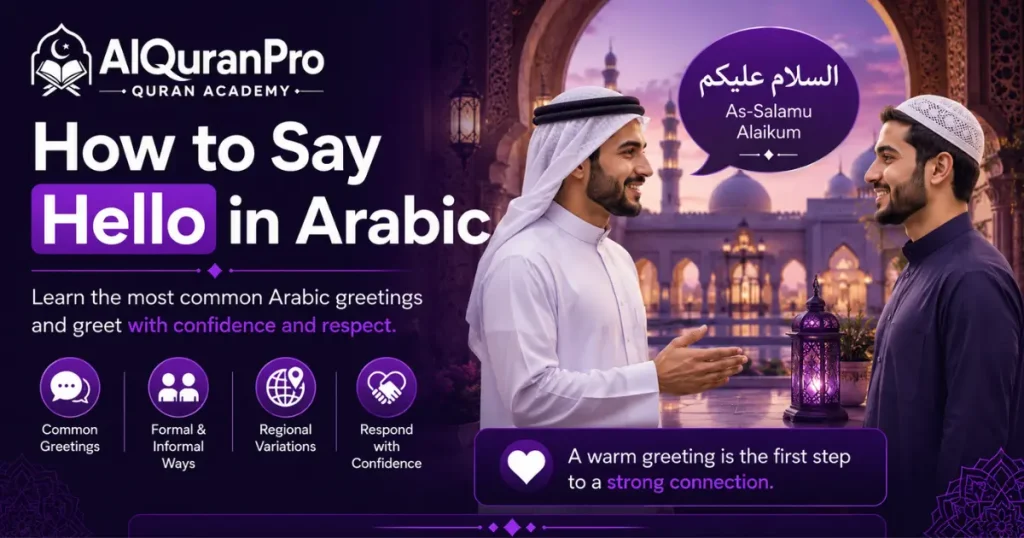
If you only remember one thing from this article, remember this. The two most useful greetings are:
- مرحبا (Marhaba), a friendly, all purpose hello that works almost anywhere.
- السلام عليكم (Assalamu Alaikum), meaning “peace be upon you,” a warmer and more traditional greeting used across the Arabic speaking world regardless of religion.
Either one will serve you well the first time you meet someone. If you want a structured way to build on these basics, a guided Arabic language course can take you from single words to full conversations far faster than memorizing phrases on your own.
Hello in Arabic Language: Formal and Informal Options
Something that surprises many learners is that Arabic does not really have one single word that maps directly onto the English “hello.” Instead there is a small family of greetings, and which one you pick depends on the setting, the person you are speaking to, and even the time of day.
Modern Standard Arabic, the version taught in schools and used in news broadcasts, is the form most textbooks describe, while everyday speech leans on regional dialects. According to Wikipedia’s overview of Modern Standard Arabic, this standardized variety developed in the late nineteenth and early twentieth centuries and is now used throughout the Arab world for education, media, and formal communication, even though most people speak a local dialect at home. As Encyclopaedia Britannica notes in its entry on the Arabic language, the language includes numerous vernacular dialects, and Modern Standard Arabic differs from them in vocabulary and style while remaining understood almost everywhere.
For a learner, the practical takeaway is simple. Marhaba and Assalamu Alaikum work in nearly every situation, formal or casual, so you rarely need to worry about which dialect you are dealing with.
Common Arabic Greetings You Will Hear Every Day
Here is a quick reference table you can come back to whenever you need a refresher.
|
Greeting |
Transliteration |
Meaning |
When to Use |
|
مرحبا |
Marhaba |
Hello |
Everyday, neutral situations |
|
أهلا |
Ahlan |
Hi |
Casual, with friends or peers |
|
أهلا وسهلا |
Ahlan wa Sahlan |
Welcome |
Hosting guests, warm introductions |
|
السلام عليكم |
Assalamu Alaikum |
Peace be upon you |
Formal or traditional greetings |
|
صباح الخير |
Sabah il Kheir |
Good morning |
Mornings, until roughly noon |
|
مساء الخير |
Masa il Kheir |
Good evening |
Afternoon and evening |
These six phrases alone will cover the overwhelming majority of situations you will encounter, whether you are traveling, chatting with coworkers, or simply practicing with a language partner.
How to Say Hi in Arabic Casually
Once you move past formal introductions, you will want something quicker and lighter. That is where أهلا (Ahlan) comes in. It is short, easy to pronounce, and works among close friends, classmates, or family members the same way a casual wave does in English. You can shorten a greeting even further by simply saying “Ahlan” with a smile, and most people will respond just as casually.
How Do You Say Hi in Arabic to Friends and Family?
With people you already know well, you can add warmth by combining greetings. Saying “Ahlan, kayfa halak?” (Hi, how are you?) to a man, or “kayfa haluki?” to a woman, signals familiarity without sounding stiff. This kind of layered greeting is extremely common in daily life and often continues for a few exchanges before the actual conversation begins.
Arabic Greetings and Responses Table
Nearly every Arabic greeting has an expected reply, and knowing the response is just as important as knowing the greeting itself. According to the Cambridge Dictionary entry for salaam, the word is simply a shortened form of the fuller phrase meaning “peace be upon you,” which explains why the standard reply mirrors that same idea back to the speaker.
|
Greeting |
Transliteration |
Standard Response |
Transliteration |
|
السلام عليكم |
Assalamu Alaikum |
وعليكم السلام |
Wa Alaikum Assalam |
|
مرحبا |
Marhaba |
مرحبا بك |
Marhaba bik |
|
أهلا |
Ahlan |
أهلا بك |
Ahlan bik |
|
صباح الخير |
Sabah il Kheir |
صباح النور |
Sabah in Noor |
|
مساء الخير |
Masa il Kheir |
مساء النور |
Masa in Noor |
The exchange between Assalamu Alaikum and Wa Alaikum Assalam is especially well documented. As Wikipedia’s entry on As salamu alaykum explains, this greeting and its reply are used across religious and cultural lines throughout Arabic speaking communities, not only in formal religious settings but in ordinary daily conversation as well.
Greetings by Time of Day
These phrases often shift with the clock, much like English speakers switch between “good morning” and “good evening.” Before midday, Sabah il Kheir is the standard choice, and people usually respond with Sabah in Noor, which literally means “morning of light.” After noon, the equivalent shifts to Masa il Kheir, answered with Masa in Noor. Unlike English, Arabic generally does not use a separate phrase for “good afternoon,” so the evening greeting simply covers the rest of the day.
Regional Greetings Across the Arab World
Arabic is spoken across roughly two dozen countries, and it holds a notable place on the global stage. It is one of only six official languages recognized by the United Nations, alongside English, French, Spanish, Russian, and Chinese, which reflects just how widely it is used in diplomacy, media, and daily communication around the world.
Because the language spans such a large geographic area, greetings pick up local flavor depending on where you are.
- Egypt: Ahlan and Izzayyak (how are you) are common in daily conversation.
- Levant (Lebanon, Syria, Jordan, Palestine): Marhaba is standard, often followed by Keefak or Keefik.
- Gulf countries: Hala and Marhaba are widely used, sometimes with the phrase Marhaba Milyon, meaning “a million welcomes.”
- North Africa: Salam is common, alongside local expressions like Labas in Morocco.
If you are curious how these dialect differences connect back to the Classical Arabic used in the Quran, browsing a full Quran translation in English alongside the original text is a useful way to see how the formal language has stayed remarkably consistent even as everyday speech evolved.
Cultural Etiquette When Greeting in Arabic
Words are only part of the picture. A few etiquette notes will help your greetings land the way they are meant to.
- A warm smile and a light handshake are appreciated in most settings, though it is polite to let the other person initiate contact, especially between men and women in more traditional settings.
- Hospitality runs deep in Arabic speaking cultures, so do not be surprised if a simple hello turns into an invitation for tea or a longer chat.
- Greetings are often repeated when entering a room full of people, since it is considered polite to acknowledge everyone individually rather than offering one general wave.
- Many greetings carry a spiritual undertone. If you want to understand this connection more deeply, exploring everyday Islamic supplications shows how phrases of peace and well wishing extend far beyond a simple hello into daily life and worship.
Practice Tips to Sound Natural
Reading a list of phrases only gets you so far. Pronunciation and rhythm matter just as much as vocabulary. Try these habits to build real fluency.
- Repeat each greeting out loud rather than just reading it silently.
- Practice full exchanges, not single words, so you get comfortable with both the greeting and its response.
- Listen to native speakers whenever possible and mimic their intonation.
- Review dialect differences gradually instead of trying to memorize every regional variation at once.
If you would rather learn with guided feedback than figure out pronunciation alone, Quran classes for beginners often include Arabic language fundamentals taught by native speakers, which can make greetings and everyday conversation click far faster. You can also start with a free trial class to see how guided instruction compares to self study.
Final Thoughts
Learning a handful of these phrases will take you further than you might expect. A well placed Marhaba or Assalamu Alaikum tells people you respect their language and culture before you have said anything else. Start with the basics in this guide, practice the responses just as much as the greeting itself, and let regional variations come naturally as you spend more time listening and speaking.
Frequently Asked Questions
What is the most common way to greet someone in Arabic?
Marhaba and Assalamu Alaikum are the two most widely used and understood greetings across nearly every Arabic speaking country.
Is Assalamu Alaikum only used by Muslims?
No. While it has strong roots in Islamic tradition, the greeting is used and understood by Arabic speakers of many backgrounds as a general expression of goodwill.
What is the difference between Marhaba and Ahlan?
Marhaba is a neutral, all purpose hello, while Ahlan feels slightly more casual and is often used with friends, family, or people you already know.
Do these greetings change by country?
Yes. While Marhaba and Assalamu Alaikum are understood everywhere, everyday greetings vary by dialect, from Izzayyak in Egypt to Keefak in the Levant and Shlonak in the Gulf.
How should I respond if someone greets me with Assalamu Alaikum?
The traditional response is Wa Alaikum Assalam, meaning “and peace be upon you too.”