Hijab vs Niqab: What Is the Real Difference in Islam?
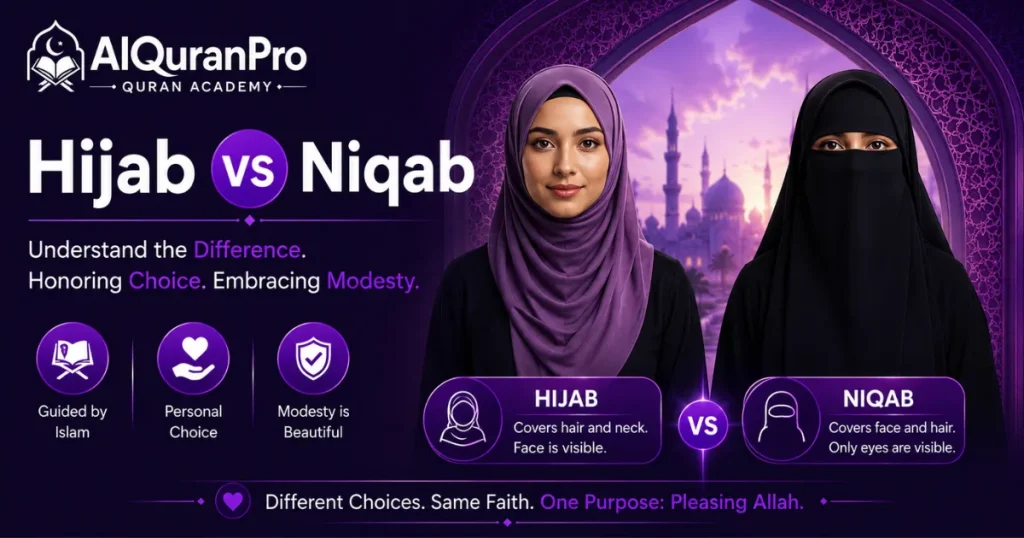
Most people have heard both words used in the news, in fashion articles, and in everyday conversation, yet very few could explain what actually separates them. The short answer is that a hijab covers the hair and neck while leaving the face open, and a niqab adds a face covering on top of that, leaving only the eyes visible. But the full picture involves scripture, centuries of scholarly debate, and a lot of personal choice that rarely makes it into headlines.
This guide walks through both garments from the ground up: where the terms come from, what Islamic scholars actually say about them, why so many women choose to wear one or the other, and how they fit alongside related garments like the jilbab, abaya, and burka.
Niqab Meaning and Its Roots in Arabic
The word niqab comes from the Arabic root that means “to pierce” or “to make a hole,” which makes sense once you picture the garment itself: a cloth veil with an opening left for the eyes. In classical Arabic usage, the term referred specifically to a face covering worn over an existing head covering, not to the head covering itself.
That distinction matters because a lot of confusion in Western media comes from treating niqab as just another word for hijab. They are related, but they are not interchangeable. According to Britannica, the niqab is one of several face and body coverings, alongside the chador and burka, that are often mistaken for a strict Islamic requirement even though scholars continue to debate how much of a woman’s body and face modest dress must actually cover.
What Is Niqab in Islamic Dress
In practical terms, a niqab is a piece of fabric, almost always black, that ties or clips around the head and drapes over the nose, mouth, and chin. It is worn together with a headscarf and often with an abaya or other loose outer garment, so the niqab itself is really just the face piece within a larger modest outfit. Some versions leave a narrow slit for both eyes, while a lighter style called the half niqab covers only up to the bridge of the nose and leaves the eyes and forehead uncovered.
It is worth being precise here because the niqab is frequently confused with the burka, which is a completely different garment. A burka covers the entire body and face, including the eyes, through a mesh panel the wearer sees through. A niqab leaves the eyes fully exposed. If you remember one distinction from this article, remember that one: niqab shows the eyes, burka does not.
What Is Hijab
Hijab is a broader term. In its narrow, everyday sense, it refers to the headscarf that covers a woman’s hair, ears, and neck while leaving the face completely visible. This is the version most commonly seen across the United States, Europe, and much of the Muslim world, and it comes in countless colors, fabrics, and wrapping styles depending on region and personal taste.
In its wider sense, hijab describes an entire standard of modest behavior and dress for both men and women, not just a piece of cloth. The Qur’an itself does not use the word hijab to mean a headscarf; it uses terms like khimar (a head covering) and jilbab (an outer cloak). Over the centuries, hijab became the everyday shorthand for the headscarf specifically, even though its original meaning is closer to “a barrier” or “a means of separation.”
Comparing the Two Side by Side
|
Feature |
Hijab |
Niqab |
|
Covers hair and neck |
Yes |
Yes (with an underlying scarf) |
|
Covers the face |
No |
Yes, except the eyes |
|
Worn with an outer robe |
Optional |
Usually, typically an abaya |
|
Considered obligatory by most scholars |
Yes |
No, though some schools recommend it |
|
Common in the West |
Very common |
Less common, but present |
Both garments are rooted in the same underlying value of haya, a concept that blends modesty, humility, and a sense of dignity in how one presents oneself in public. Where they differ is in degree, not in intent.
Why Do Women Wear Niqab
The reasons vary widely and rarely match the stereotypes that circulate in Western media. For many women, wearing the niqab is a personal spiritual milestone reached after years of practicing hijab, a step taken once they feel ready for a deeper level of modesty. Others adopt it because it reflects the customs of their family, region, or community, particularly in parts of the Gulf and South Asia where face covering has long been culturally common.
Common reasons women give for choosing the niqab include:
- A desire to be judged for character and intellect rather than appearance
- A feeling of increased privacy and protection from unwanted attention
- A sense of closeness to God through an extra act of devotion
- Personal comfort and confidence once they have worn it for a period of time
- Alignment with family or community tradition
It is also worth noting that plenty of women wear hijab their entire lives without ever adopting the niqab, and Islamic scholarship generally treats both as legitimate paths. The Qur’an instructs believing women to lower their gaze, guard their modesty, and draw their coverings over their chests, a verse found in Surah An-Nur that forms much of the scriptural basis for hijab as a practice.
What Islamic Scholars Say About the Niqab
Scholars agree almost unanimously that covering the hair is required. Where they split is on the face. The Hanbali school leans toward encouraging or requiring the niqab, particularly in situations where a woman’s beauty might attract unwanted attention. The Hanafi, Maliki, and Shafi’i schools generally view the niqab as recommended rather than obligatory, treating the face and hands as parts of the body that do not need to be covered under ordinary circumstances.
Egypt’s Dar Al Ifta, one of the most cited religious authorities in the Muslim world, has issued a detailed ruling on this exact question. Its position holds that covering the face is not obligatory for a Muslim woman, and that a woman who wears the niqab earns spiritual reward for doing so without being at fault if she chooses not to. That single ruling captures the mainstream scholarly consensus fairly well: the niqab is respected, never discouraged, but not treated as a strict requirement the way the headscarf is.
If you want to explore these classical rulings and the verses behind them in more depth, our Islamic studies courses walk through Qur’an, Hadith, and fiqh with qualified teachers rather than secondhand summaries.
Jilbab vs Hijab: How the Two Garments Differ
The jilbab often gets lumped in with hijab, but it serves a different function entirely. A jilbab is a loose, ankle length outer garment that covers the entire body except the face, hands, and feet, similar in concept to a long coat or cloak worn over regular clothing. A hijab, by contrast, is specifically the headscarf. In practice, many women wear both together: the jilbab handles body coverage while the hijab covers the hair and neck. Think of the jilbab as the outer shell and the hijab as the finishing piece around the head.
Abaya vs Hijab: Two Different Purposes
The same logic applies to the abaya, a long, flowing robe worn over clothing that is especially common in the Gulf states. An abaya covers the body from the shoulders down, typically in black or a dark, understated color, and is not designed to cover the hair at all. A woman wearing an abaya will almost always pair it with a separate hijab, since the abaya alone leaves the head uncovered. So the comparison of abaya vs hijab is really a comparison of body coverage versus head coverage, two garments that complement rather than compete with each other.
Hijab vs Burka vs Niqab vs Abaya: A Full Comparison
Putting all four garments in one place makes the distinctions much easier to remember.
- Hijab: A headscarf covering the hair and neck, face fully visible.
- Niqab: A face veil covering the nose, mouth, and chin, eyes visible, worn with a headscarf.
- Burka: A full body and face covering with a mesh panel over the eyes, the most concealing of the four.
- Abaya: A loose outer robe covering the body, worn over regular clothes and paired with a hijab for head coverage.
None of these four garments are interchangeable, even though casual conversation (and more than a few online articles) tends to blur them together. Coverage level increases roughly in this order: hijab, then niqab, then burka, with the abaya running alongside all three as a body layer rather than a head or face covering.
Niqab and Hijab in the United States
For American readers, the practical question is often less about theology and more about how these garments are received socially and legally. Unlike several European countries that have passed partial or full bans on face coverings in public spaces, the United States has no federal law restricting the niqab or burka. Interestingly, American public opinion also differs sharply from much of Western Europe on this issue. A Pew Research Center survey found that a clear majority of Americans, 65 percent, opposed a ban on full veils in public places, in contrast to strong majority support for such bans in France, Germany, and Spain.
That gap says something important: in the American context, veiling tends to be treated as a matter of individual religious freedom rather than a public policy debate, even though misunderstanding and occasional discrimination against niqab wearing women still happens in workplaces, schools, and airports.
Women exploring how modesty fits into daily practice, including how it applies during prayer, often find it helpful to study the topic properly rather than relying on assumptions. Our prayer lessons in Islam cover modesty requirements as part of a wider look at how salah is performed correctly.
Final Thoughts
The difference between hijab and niqab ultimately comes down to how much of the face a woman chooses, or is guided by her school of thought, to cover. Hijab is close to universal among practicing Muslim women and is treated as a clear religious obligation. Niqab is a further step taken by a smaller number of women, respected across almost all schools of thought but not required by most of them. Understanding that distinction, along with how jilbab, abaya, and burka fit into the picture, clears up a topic that is far more nuanced than most headlines suggest.
For readers who want to go deeper into Qur’anic guidance on modesty and other topics, our team of female Quran teachers offers one on one classes designed specifically for women, and our online Quran classes for ladies cover these questions alongside Tajweed, memorization, and Tafsir. If you are curious about the structure of the Qur’an itself, our article on how many pages are in the Quran is a good place to start.
Frequently Asked Questions
Is niqab mandatory in Islam?
No. The majority of scholars view it as recommended rather than obligatory. Hijab, on the other hand, is considered obligatory by the vast majority of Islamic scholarship.
Can a woman wear niqab without hijab?
Not really, since the niqab is a face veil worn on top of a headscarf. A woman wearing niqab is, by definition, also covering her hair.
Do all Muslim women wear niqab?
No. Most Muslim women worldwide wear hijab without a face veil. Niqab is far less common and tends to concentrate in specific regions and communities.
Is niqab the same as burka?
No. A niqab leaves the eyes visible; a burka covers the eyes as well, using a mesh panel to see through.