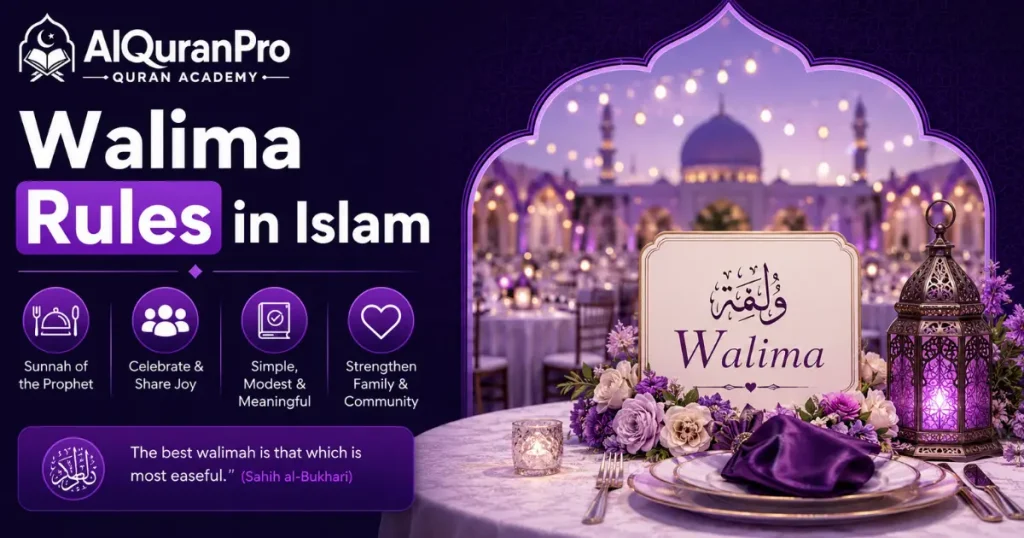
Walima Rules in Islam: A Complete Sunnah Guide for Muslim Couples
Getting married is one of the most joyful moments in a Muslim’s life, and the walima is Islam’s way of sharing that joy with everyone around you. Yet many couples planning a wedding in the United States are not fully sure what the walima rules in Islam actually require, and what is simply local custom dressed up as religion.
So what is walima? In short, it is the marriage feast the groom hosts after the nikah to publicly celebrate and announce the marriage. It is not the wedding contract itself, that is the nikah, but the meal and gathering that follows it. The majority of scholars agree that walima is a strongly emphasized sunnah, something the Prophet Muhammad, peace be upon him, consistently practiced and encouraged, though most scholars do not consider it a strict legal obligation like prayer or fasting.
This guide walks through the actual rules, drawn from hadith and classical fiqh, along with practical advice for hosting a walima that feels authentic whether you are in Chicago, Houston, or anywhere else in the US.
The Origin and Meaning of Walima
The walima meaning comes from the Arabic root word walam, which means to gather or bring together. Arabs originally used it for any feast where people were invited to gather, and over time the term became specific to the wedding banquet. You will sometimes see it spelled valima meaning the exact same celebration, or written as balima meaning the identical Sunnah feast, since transliterating Arabic into English produces several accepted spellings depending on the region and the writer.
Whatever spelling you come across, the practice refers to the same thing: a meal hosted to celebrate a marriage and make it known to family, friends, and the wider community.
Is Walima Obligatory or Just Recommended?
This is probably the single most common question couples ask, and the answer matters because it shapes how much pressure people feel around hosting one. According to the majority of classical jurists, walima falls under sunnah muakkadah, a strongly emphasized practice of the Prophet, peace be upon him, rather than a strict fard. Imam Ibn Qudamah, the great Hanbali scholar, wrote in his famous work al Mughni that scholars do not differ on walima being a prescribed sunnah at the time of marriage, since the Messenger of Allah both ordered it and practiced it himself, while also noting that most scholars do not treat it as wajib.
So is walima compulsory in Islam? For the vast majority of scholars, no, it is highly recommended rather than legally required. A smaller group of jurists lean toward it being closer to obligatory given how consistently the Prophet performed it. Practically speaking, this means a Muslim couple who skips the walima due to genuine hardship has not sinned, but a couple who can afford even a modest gathering is missing out on real reward by avoiding it entirely.
10 Walima Rules in Islam Every Couple Should Know
1. Walima Is a Strongly Emphasized Sunnah
As covered above, walima is not a pillar of Islam and it is not required in the way that prayer or fasting is. It is, however, one of the more strongly encouraged sunnahs connected to marriage. Skipping it without a valid reason means missing a beautiful opportunity for blessing, gratitude, and community, even if it carries no sin.
2. Hosting Responsibility Falls on the Groom
Traditionally, the groom and his family are responsible for organizing and paying for the walima. This reflects the husband’s broader role as provider from the very start of married life. That said, plenty of modern families in the US split costs between both sides, or the bride’s family contributes voluntarily, and none of this contradicts Islamic teaching as long as it happens by mutual agreement rather than pressure.
3. It Should Follow the Nikah, Ideally After Consummation
A frequent question is walima after how many days of nikah it should actually be held. The majority opinion, supported by the practice of the Prophet, peace be upon him, is that walima traditionally takes place after the marriage is consummated. Anas ibn Malik narrated that when the Prophet consummated his marriage to Zaynab bint Jahsh, he sent an invitation for people to come and eat together afterward, a narration you can read in full on Sunnah.com. Some scholars allow it around the time of the contract or the wedding procession too, so there is genuine flexibility here, and many US based couples now combine the nikah and walima into a single event for practical reasons like guests traveling from out of state.
4. The Feast Should Not Extend Past a Few Days
Hanafi jurists generally hold that a feast is only considered a walima if it happens within the first day or two after consummation. A hadith recorded in Sunan Abi Dawud describes the Prophet saying that walima on the first day fulfills the right, on the second day it is still commendable, and by the third day it starts to resemble showing off rather than sincere celebration.
5. Keep It Simple and Avoid Extravagance
This might be the rule culture violates most often. The Prophet told Abdur Rahman ibn Awf to hold a walima even if it was only with one sheep, a narration cited earlier from Sahih al Bukhari. The point was never the size of the feast, it was the sincerity behind it. Going into debt or competing with other families to throw the biggest wedding contradicts the spirit of the sunnah entirely, and it is worth reading about the dangers of showing off, since ostentation is treated seriously among the major sins in Islam.
6. Invite People From All Walks of Life
Abu Huraira narrated that the Prophet described the worst kind of walima as one where only the wealthy are invited while the poor are excluded, a hadith recorded in Sahih al Bukhari. Neighbors, relatives, coworkers, and community members from every economic background should feel welcome, not just people who can reciprocate socially or financially.
7. Guests Should Accept the Invitation
Islam places real weight on attending a walima once invited, barring a genuine excuse like illness or travel. Several hadith describe refusing a walima invitation without cause as disobedience toward Allah and His Messenger. Guests are not obligated to eat if they are fasting or simply not hungry, but showing up and offering dua for the couple is part of fulfilling the sunnah together.
8. The Food Must Be Halal and Offered With Sincerity
Every dish served at a walima needs to meet halal standards, and the quality of the feast should reflect the host’s actual means rather than a desire to impress. A humble meal offered wholeheartedly carries more blessing than an extravagant spread meant to earn compliments.
9. Cultural Additions Should Not Override Islamic Etiquette
Many communities have layered local customs onto the walima that sit uneasily with Islamic modesty, from excessive mixed gatherings to elaborate displays that put pressure on families financially and socially. Basic principles of modest dress and interaction between men and women, similar to the guidance behind hijab and niqab, still apply at these gatherings regardless of how big or small the event is.
10. Center the Occasion Around Gratitude and Dua
Beyond the food and the guest list, a walima is ultimately meant to be an act of gratitude to Allah for the blessing of marriage. Encouraging guests to offer supplications for the couple, and opening or closing the gathering with a short dua, keeps the spiritual purpose of the day front and center rather than letting logistics take over completely.
What Do the Four Madhabs Say About Walima?
|
Madhab |
Ruling on Hosting Walima |
Ruling on Accepting Invitation |
|
Hanafi |
Sunnah muakkadah, strongly emphasized |
Sunnah muakkadah, close to necessary |
|
Shafii |
Recommended, some scholars lean toward obligatory |
Personally obligatory unless there is an excuse |
|
Maliki |
Recommended sunnah |
Strongly recommended, obligatory in some views |
|
Hanbali |
Prescribed sunnah per Ibn Qudamah, not wajib |
Obligatory to attend absent a valid excuse |
While the exact wording differs, all four schools agree that walima carries real religious weight, and that ignoring the practice entirely without reason means missing a significant sunnah of the Prophet, peace be upon him.
Walima vs Nikah: What Is the Actual Difference?
People often use these terms interchangeably, but they refer to two separate things. The nikah is the legal and spiritual marriage contract itself, completed with an offer, acceptance, witnesses, and a mahr agreed upon for the bride, a bond the Quran describes as one built on tranquility, love, and mercy between spouses in Surah Ar Rum.
The walima is the celebratory feast that follows, meant to publicly announce that the marriage has taken place, in keeping with the Prophet’s instruction to announce marriages rather than keep them hidden. A couple is fully married once the nikah is complete, with or without a walima, though hosting the feast afterward fulfills a beloved sunnah and makes the union publicly known rather than kept quiet.
Walima Rules for Muslim Couples in the United States
Planning a walima in America comes with its own set of practical questions that classical fiqh texts obviously never anticipated. Understanding the walima ceremony meaning helps couples balance authenticity with the realities of American venues, guest lists, and budgets.
Halal catering has become widely available in most major US cities, making it far easier to serve guests appropriately without sourcing food yourself. Many couples now combine the nikah and walima into one afternoon or evening event at a community hall or hotel banquet room, which cuts costs and simplifies travel for out of town guests. On the guest list side, it is entirely acceptable to invite non Muslim friends, coworkers, and neighbors to a walima, since sharing joy with the wider community reflects the openness Islam encourages rather than working against it.
Gender mixing norms vary by community. Some families hold fully separate celebrations for men and women, others use divided seating within the same hall, and some hold a single mixed gathering with modest etiquette observed throughout. None of these formats is inherently more correct than another, as long as basic principles of modesty and respect are maintained.
Final Thoughts
Understanding the real walima rules in Islam helps couples move past cultural pressure and back toward the simplicity the Prophet Muhammad, peace be upon him, actually modeled. A walima does not need to be extravagant to be meaningful, it needs to be sincere, inclusive, and rooted in gratitude to Allah.
If you want to strengthen your understanding of the faith behind these practices, exploring the foundations of iman in Islam is a great next step, and couples looking to deepen their knowledge further can also explore structured Islamic studies courses designed for adult learners. May every couple find their walima to be a source of barakah, community, and lasting joy in their married life.
Frequently Asked Questions
Do I have to hold a walima, or can I skip it?
You are not sinful for skipping it if you have a genuine excuse, since most scholars classify it as a strongly emphasized sunnah rather than a strict obligation, though a minority of jurists lean closer to treating it as necessary for those who can afford it.
Is walima mandatory in Islam according to every school of thought?
Not universally. All four major madhabs encourage it strongly, and several hold that accepting a walima invitation is closer to mandatory than hosting one is, but none of the four treat hosting a walima as an absolute legal requirement.
Can the nikah and walima happen on the same day?
Yes. While the majority opinion favors holding the walima after consummation, many scholars accept combining both events on one day, and this has become increasingly common for practical reasons among Muslim families in the US.
Who is supposed to pay for the walima?
Traditionally the groom and his family cover the cost, though modern arrangements where both families contribute are common and do not conflict with Islamic teaching.
How many days can a walima celebration last?
Most Hanafi jurists limit a true walima to the first day or two after consummation, with a hadith warning that celebrating into a third day starts to resemble showing off rather than sincere gratitude.
Can non Muslims be invited to a walima?
Yes, inviting non Muslim friends, colleagues, and neighbors is permitted and reflects the inclusive, community building spirit behind the celebration.