A Complete Guide to Judgement Day: Signs, Timing and Meaning in Islamic Teaching
Every believer eventually asks the same question in some form: when is the day of judgement, and can anyone actually know the date? The short answer, according to Islamic teaching, is that no human being, not even the Prophet Muhammad, peace be upon him, was ever told the exact date. What Muslims do have is a rich body of guidance from the Quran and authentic hadith describing the signs that will come before it, the events that will unfold on that day, and how a person should live while waiting for it. This article walks through all of that in plain language, with real sources you can check for yourself.
What Is the Day of Judgement in Islam?
In Islamic belief, the Day of Judgement is called Yawm al Qiyamah, which translates roughly to the Day of Standing or the Day of Resurrection. It is the moment when every soul that has ever lived will be raised from death and brought before Allah to answer for everything they did, said, and intended during their time on earth. It is one of the six articles of faith in Islam, sitting alongside belief in Allah, the angels, the revealed books, the prophets, and divine decree.
The idea behind it is simple and, honestly, quite fair. Life on earth involves countless choices, some kind, some cruel, many hidden from other people. Islam teaches that nothing done in secret stays hidden forever. On that day, a person’s full record, recorded continuously by angels throughout their life, will be opened and reviewed. Good deeds and bad deeds will be weighed, and the outcome will decide whether someone enters Paradise or faces punishment.
When Will the Day of Judgement Happen?
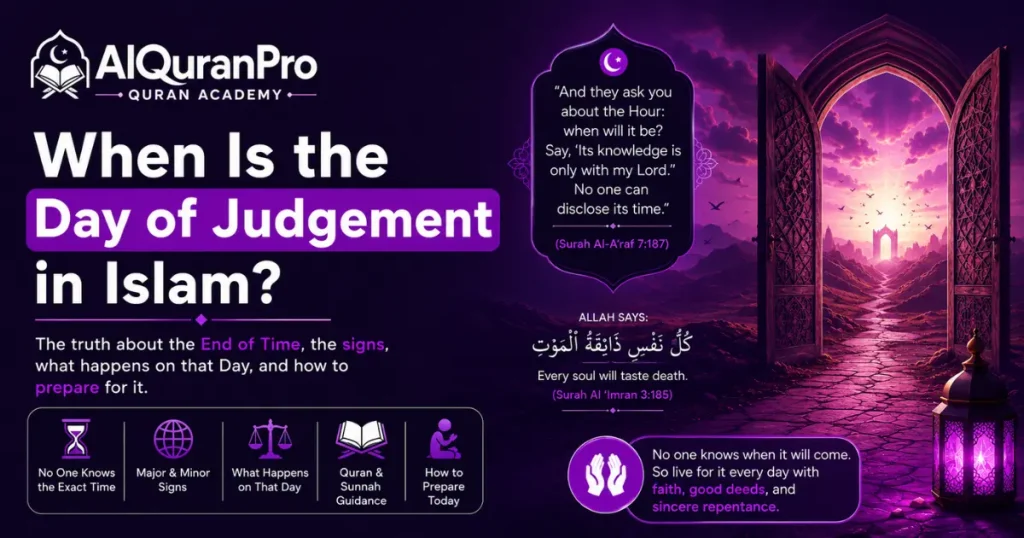
This is where most confusion comes from, and it is worth addressing directly. Its timing is described in the Quran as knowledge that belongs to Allah alone. In Surah Al A’raf, people ask the Prophet directly about the timing of what the Quran calls “the Hour.” The response, as translated on Quran.com, makes it clear that this knowledge rests with Allah, that it will arrive suddenly, and that even the Prophet himself was not given a specific date.
This single verse settles a lot of speculation. Anyone claiming to know the exact year, month, or day is going against a fundamental teaching of the Quran itself. Scholars throughout Islamic history have repeated this point consistently: certainty about the date is not something granted to any human being.
Why the Friday Tradition Exists
Even though the exact date is unknown, several authentic hadith mention that the Hour will take place on a Friday. Abu Hurairah reported that the Prophet said the best day the sun has risen upon is Friday, the day Adam was created, the day he entered Paradise, the day he was sent down from it, and the day the Last Hour will take place, a narration recorded in Sahih Muslim.
This is often where the confusion begins, and it is actually a fair question that gets asked a lot, including in casual discussions online. If it is Friday in one part of the world, it is a different day somewhere else, so how can the Hour “be” Friday everywhere at once? Islamic scholars generally explain that the hadith refers to the Hour beginning at a moment that Allah has chosen, and that human confusion about time zones does not change divine knowledge or divine timing. The claim that it will specifically be the tenth of Muharram is far weaker and is not something most scholars accept as reliably established, since it lacks the same strength of narration as the Friday tradition.
Major Signs Before the Hour
While the date stays hidden, Islam teaches that certain unmistakable events will happen shortly before the Hour arrives. One well known hadith, narrated by Hudhaifa ibn Usaid and recorded in Sahih Muslim, lists ten major signs the Prophet described, including the appearance of a great smoke, the emergence of Dajjal, a beast that comes out of the earth, the sun rising from the west instead of the east, the descent of Jesus, the emergence of Gog and Magog, and three massive landslides in the east, the west, and the Arabian Peninsula.
These are considered the major signs because none of them has occurred yet, and their arrival is expected to happen close together, near the very end of time. Scholars differ slightly on the exact order, but the general understanding is that Dajjal, described as a great deceiver, will be among the first of these events, followed by the return of Jesus, who according to Islamic belief will defeat him.
Minor Signs Already Unfolding
Alongside the major signs, Islamic teaching also describes minor signs, smaller and more gradual changes in society that serve as reminders. These include things like widespread moral decline, people competing to build taller structures, knowledge of religion becoming scarce while ignorance spreads, time seeming to pass faster, and an increase in disasters and open sinfulness. Many scholars point out that a number of these have already appeared in some form throughout history, which is part of why the topic is often paired with reminders about avoiding major sins in Islam and correcting one’s own conduct rather than trying to predict a date.
The Encyclopedia of Translated Prophetic Hadiths documents many of these narrations in detail, offering a useful reference for anyone who wants to read the original wording alongside scholarly explanation rather than relying on secondhand summaries.
What Actually Happens on That Day
Understanding what actually unfolds means looking past just the timing and into the actual sequence of events Islamic sources describe. After the trumpet is blown and all creation is resurrected, people will be gathered on a vast plain to wait for judgment. This waiting period is described as intensely difficult, with the sun brought close and people standing according to their deeds.
From there, several key events are described across the Quran and hadith literature. A scale called the Mizan will weigh each person’s good and bad deeds. Books recording every action will be handed out, placed in the right hand for those who lived righteously and in a more troubling manner for those who did not. A bridge called the Sirat will stretch over Hell, and people will cross it according to how they lived, with the righteous passing safely and others falling. Intercession, meaning the ability of the Prophet and righteous individuals to plead for mercy on behalf of others, is also part of Islamic belief about this process, though final judgment always belongs to Allah alone.
Britannica’s overview of the Last Judgment across world religions notes that Islam shares broad structural similarities with Christian and Jewish concepts of a final reckoning, including the weighing of deeds and eventual separation between the righteous and the condemned, while still holding its own distinct details rooted in the Quran and Sunnah.
When Will Judgement Day Come in Islam? Common Misconceptions
A lot of the confusion people run into, including in online discussions where this question gets asked in a dozen different forms, comes from mixing up three separate things: the general signs, specific date predictions, and personal end of life. Death is sometimes referred to as a person’s “smaller resurrection,” since once someone dies, their own opportunity to earn reward effectively closes, even though the collective Day of Judgement for all of humanity has not yet arrived. Scholars are also clear that predicting the actual date, whether through numerology, calendar calculations, or claims of secret knowledge, contradicts the Quran’s own statement that this information belongs to Allah alone.
How Muslims Prepare for the Hour
Since the date cannot be known, Islamic teaching focuses heavily on readiness rather than prediction. Consistent prayer is often described as the foundation of this preparation, and learning the basics through resources like a structured prayer lesson in Islam is usually one of the first steps recommended to someone trying to strengthen their practice. Reading and understanding scripture matters just as much, and many people find it easier to start with a clear Quran translation in English before moving into deeper study.
Supplication also plays a major role. Many Muslims regularly recite specific duas asking for protection from the trials of the grave and from Dajjal, drawing on collections of islamic supplication used daily by practicing believers. Beyond personal worship, ongoing learning through structured islamic studies online courses is commonly recommended for anyone who wants a deeper, more organized understanding of these topics instead of piecing information together from scattered sources.
Final Thoughts
The honest answer to when this day will happen is that nobody knows, and Islamic teaching treats that uncertainty as intentional rather than a gap to be solved. What the Quran and hadith give instead is a detailed picture of what to expect and, more importantly, clear guidance on how to live in the meantime. For most scholars and everyday believers alike, that shift in focus, from predicting a date to preparing a life, is really the entire point of the teaching.
Frequently Asked Questions
Does the Quran give a specific date for Judgement Day?
No. The Quran states plainly that knowledge of the exact timing belongs only to Allah, and that it will come suddenly and without warning.
Why do some hadith mention Friday specifically?
Several authentic narrations describe Friday as the day the Hour will take place, tied to the same day Adam was created and later passed away, though the precise year remains unknown.
Is the belief about the tenth of Muharram accurate?
Most scholars view this claim as weak and not well supported compared to the stronger, widely accepted Friday narrations.
What are the two categories of signs before Judgement Day?
Islamic tradition divides them into minor signs, which are gradual social and spiritual changes, and major signs, which are ten dramatic events expected to occur close together near the very end.
Can good deeds change the outcome of the judgment?
Yes. Islamic belief holds that sincere repentance, consistent good deeds, and Allah’s mercy all play a role in the final outcome for each individual.