Four Qul Explained: Full 4 Qul Surah in Arabic and English
If you grew up in a Muslim household, chances are someone taught you these surahs before you even understood what they meant. They are short, they carry a rhythm that makes them easy to remember, and they hold meanings that scholars have written entire books about. This guide brings all four surahs together in Arabic, transliteration, and English, along with the hadith that explain why Muslims have recited them for over fourteen centuries.
Whether you are a parent teaching a child, a new Muslim building your recitation, or someone who simply wants to understand what these chapters mean, everything you need is gathered here in one place.
Why Are They Called Qul?
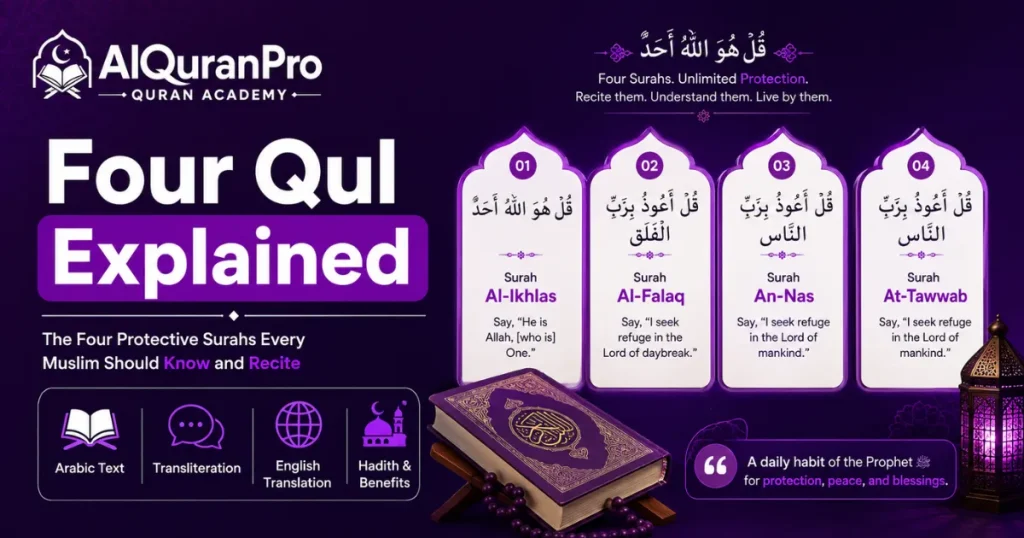
The word Qul means “say” in Arabic. It is a command from Allah directed at the Prophet Muhammad (peace be upon him), instructing him to recite specific words to the people around him. Four separate chapters in the Quran open with this word, and because of that shared opening, they became known together as a set.
Muslims across different countries refer to this set by slightly different names depending on language and region, but the surahs themselves never change.
The Surahs in This Set
The four surahs are:
- Surah Al Kafirun (Chapter 109)
- Surah Al Ikhlas (Chapter 112)
- Surah Al Falaq (Chapter 113)
- Surah An Nas (Chapter 114)
Getting familiar with these four quls in depth helps you recite them with more sincerity, since each one carries a distinct theme even though they are often grouped together. Al Kafirun is a declaration of faith. Al Ikhlas explains the oneness of Allah. Al Falaq and An Nas are prayers of protection, often recited as a pair.
Here is a quick comparison so you can see how they relate to one another:
|
Surah |
Chapter Number |
Ayahs |
Core Theme |
|
Al Kafirun |
109 |
6 |
Rejecting false worship |
|
Al Ikhlas |
112 |
4 |
The oneness of Allah |
|
Al Falaq |
113 |
5 |
Refuge from outward harm |
|
An Nas |
114 |
6 |
Refuge from inward whispers |
All four are Meccan surahs, meaning they were revealed before the Prophet’s migration to Medina, and all four sit within the final section of the Quran known as Juz Amma. This is why so many readers look up the 4 quls quran text in one place rather than searching each surah separately, since they belong together both in meaning and in placement.
Full 4 Qul Surah Text With Arabic, Transliteration and Meaning
Below is the complete text of each surah so you can read, learn, and recite them accurately. Whenever someone mentions the 4 qul quran, they usually mean these same short yet powerful chapters.
1. Surah Al Kafirun (The Disbelievers)
Arabic
قُلْ يَا أَيُّهَا الْكَافِرُونَ لَا أَعْبُدُ مَا تَعْبُدُونَ وَلَا أَنتُمْ عَابِدُونَ مَا أَعْبُدُ وَلَا أَنَا عَابِدٌ مَّا عَبَدتُّمْ وَلَا أَنتُمْ عَابِدُونَ مَا أَعْبُدُ لَكُمْ دِينُكُمْ وَلِيَ دِينِ
Transliteration
Qul ya ayyuhal kafirun La a’budu ma ta’budun Wala antum ‘abiduna ma a’bud Wala ana ‘abidun ma ‘abadtum Wala antum ‘abiduna ma a’bud Lakum deenukum waliya deen
English Meaning
Say, “O disbelievers, I do not worship what you worship. Nor are you worshippers of what I worship. Nor will I be a worshipper of what you worship. Nor will you be worshippers of what I worship. For you is your religion, and for me is my religion.”
This surah draws a clear line between belief and disbelief. It was revealed at a time when the leaders of Mecca offered the Prophet a compromise, asking him to worship their idols for a portion of the year in exchange for their worship of Allah during another portion. This surah was the answer, and it remains a firm reminder that faith is not something to be diluted or negotiated.
2. Surah Al Ikhlas (The Purity)
Arabic
قُلْ هُوَ اللَّهُ أَحَدٌ اللَّهُ الصَّمَدُ لَمْ يَلِدْ وَلَمْ يُولَدْ وَلَمْ يَكُن لَّهُ كُفُوًا أَحَدٌ
Transliteration
Qul huwallahu ahad Allahus samad Lam yalid walam yulad Walam yakul lahu kufuwan ahad
English Meaning
Say, “He is Allah, who is One, Allah, the Eternal Refuge. He neither begets nor is born, nor is there to Him any equivalent.”
Despite being only four lines long, this is one of the most repeated surahs in the entire Quran. If you want the 4 qul in english explained simply, this surah is the easiest starting point because its message is direct: there is nothing and no one comparable to Allah. According to a hadith recorded by Imam Bukhari, the Prophet described this surah as being equal in reward to one third of the Quran, and you can read the full narration on Sunnah.com, which hosts the complete authenticated hadith collections in Arabic and English.
3. Surah Al Falaq (The Daybreak)
Arabic
قُلْ أَعُوذُ بِرَبِّ الْفَلَقِ مِن شَرِّ مَا خَلَقَ وَمِن شَرِّ غَاسِقٍ إِذَا وَقَبَ وَمِن شَرِّ النَّفَّاثَاتِ فِي الْعُقَدِ وَمِن شَرِّ حَاسِدٍ إِذَا حَسَدَ
Transliteration
Qul a’udhu birabbil falaq Min sharri ma khalaq Wamin sharri ghasiqin idha waqab Wamin sharrin naffathati fil ‘uqad Wamin sharri hasidin idha hasad
English Meaning
Say, “I seek refuge in the Lord of daybreak, from the evil of that which He created, and from the evil of darkness when it settles, and from the evil of the blowers in knots, and from the evil of an envier when he envies.”
This surah is a direct request for protection against harm that comes from outside a person, whether that harm is physical, environmental, or rooted in the jealousy of others.
4. Surah An Nas (Mankind)
Arabic
قُلْ أَعُوذُ بِرَبِّ النَّاسِ مَلِكِ النَّاسِ إِلَٰهِ النَّاسِ مِن شَرِّ الْوَسْوَاسِ الْخَنَّاسِ الَّذِي يُوَسْوِسُ فِي صُدُورِ النَّاسِ مِنَ الْجِنَّةِ وَالنَّاسِ
Transliteration
Qul a’udhu birabbin nas Malikin nas Ilahin nas Min sharril waswasil khannas Alladhi yuwaswisu fi sudurin nas Minal jinnati wan nas
English Meaning
Say, “I seek refuge in the Lord of mankind, the Sovereign of mankind, the God of mankind, from the evil of the retreating whisperer, who whispers into the breasts of mankind, from among the jinn and mankind.”
While Al Falaq addresses harm from the outside, An Nas focuses on protection from within, particularly the whispers and doubts that can creep into a person’s heart and mind. Together, these two surahs are known as Al Muawwidhatayn, meaning “the two that grant refuge.” You can read the original Arabic script alongside a verified translation and audio recitation on Quran.com, a widely used reference for reading the Quran online.
What the Hadith Say About These Surahs
The virtues of these surahs are not based on opinion. They come from authentic hadith narrated by the Prophet’s own companions.
Aisha (may Allah be pleased with her) reported that every night before sleeping, the Prophet would cup his hands together, recite Al Ikhlas, Al Falaq, and An Nas into them, blow gently, and then wipe his hands over his body, starting from his head and face and covering as much as he could reach. He repeated this three times. This narration is recorded in Sahih al Bukhari, and you can read the full hadith text on Sunnah.com.
When the Prophet fell seriously ill during his final days, Aisha recited these same protective surahs over him and wiped his body with his own hand, hoping for the blessing that came from his touch. This shows that these surahs were not only recited for general protection but were also turned to during moments of real hardship and sickness.
Scholars have also explained in detail why Surah Al Ikhlas carries the weight of one third of the Quran, since the Quran’s teachings are often summarized as covering three broad categories: stories of the past, rulings for daily life, and knowledge of Allah’s attributes. Al Ikhlas addresses that third category directly. A detailed scholarly explanation of this concept is available through Islam Question and Answer, a well known resource for researched Islamic rulings and explanations.
Three Quls or Four? Clearing Up the Confusion
This is one of the most common points of confusion. Some people refer to “the three quls” when they mean only Al Ikhlas, Al Falaq, and An Nas, since these three are grouped together in several hadith about nightly recitation. Others include Al Kafirun to make a complete set, since it also opens with the word Qul and is recited by the Prophet during the pre dawn prayer alongside Al Ikhlas.
Neither usage is wrong. It simply depends on the specific hadith or tradition being referenced. A closer look at the original Arabic naming convention for this group is available on Wikipedia, which documents how the term has been used historically across different Islamic traditions.
When and How to Recite These Surahs
There is no single required time to recite these surahs, but certain occasions are strongly recommended based on the Sunnah:
- Before sleeping, following the example of the Prophet reciting Al Ikhlas, Al Falaq, and An Nas into his cupped hands.
- After the five daily prayers, particularly Al Falaq and An Nas, as part of the regular remembrance many Muslims practice.
- In the morning and evening, as a form of daily protection.
- When feeling unwell or anxious, since these surahs were used by the Prophet himself during illness.
- While traveling, for general safety and peace of mind.
If you are just beginning to learn these surahs, reading them slowly with correct pronunciation matters more than reciting them quickly. Our Quran recitation course with Tajweed can help you learn the proper articulation points so your recitation is both accurate and confident.
Memorizing These Surahs
Because each surah is short, from four to six ayahs each, they are usually among the very first chapters taught to children and new Muslims. Many teachers recommend starting with Al Ikhlas since it is the shortest, then moving to Al Falaq and An Nas as a pair, and finally learning Al Kafirun once the student is comfortable with slightly longer verses.
If you would like structured guidance rather than memorizing on your own, our Quran memorization course walks students through each surah step by step with a qualified teacher, which tends to make retention far stronger than memorizing from a book alone.
For readers who want to understand the meaning behind every word rather than just memorizing sounds, our Quran translation course covers the full text of the Quran in English, including detailed explanations of shorter chapters like these.
A Few Practical Notes
These surahs sit in the final juz of the Quran, one of the shortest sections in terms of page count. If you are curious about how the Quran is structured overall and want to know exactly where these chapters fall, our article on how many pages are in the Quran breaks down the full layout juz by juz.
It is also worth mentioning that reciting these surahs is not treated as a substitute for medical treatment or professional care. If you are dealing with physical discomfort such as a headache, many people pair spiritual practices like reciting Al Falaq and An Nas with a specific supplication. You can read more in our guide on the best dua for a headache, which explains both the spiritual and practical side of seeking relief.
Final Thoughts
Some people write it as four qul, others spell it 4 kul, and some simply type qul 4 into a search bar when they cannot remember the full name. All of these searches lead back to the same short, powerful surahs that Muslims have relied on for protection, faith, and peace of mind for over a thousand years. Learning to read them correctly, understand their meaning, and recite them consistently is a small habit that carries lasting spiritual weight.
If you would like personal guidance on pronunciation, memorization, or understanding the deeper meaning of these surahs, the qualified teachers at AlQuranPro Academy are ready to help you build a consistent, confident recitation practice.
Frequently Asked Questions
What are these four surahs called?
They are Surah Al Kafirun, Surah Al Ikhlas, Surah Al Falaq, and Surah An Nas.
Why do these surahs start with the word Qul?
Qul means “say” in Arabic, and it is Allah’s direct command to the Prophet to recite the words that follow. All four surahs share this same opening word, which is why they are grouped together.
Is Surah Al Kafirun included in this group, or only in the three quls?
It depends on the tradition being referenced. Some hadith group only Al Ikhlas, Al Falaq, and An Nas together for nightly recitation, while the broader grouping includes Al Kafirun as well, since it also opens with Qul.
What is the reward for reciting Surah Al Ikhlas?
According to an authentic hadith, the Prophet said that reciting Surah Al Ikhlas carries a reward equal to reciting one third of the entire Quran.
Can children memorize these surahs easily?
Yes. Because each surah ranges from only four to six ayahs, they are commonly the first chapters taught to children, often starting with Al Ikhlas due to its short length and simple structure.