How Did Prophet Muhammad Die? A Clear and Sourced Timeline
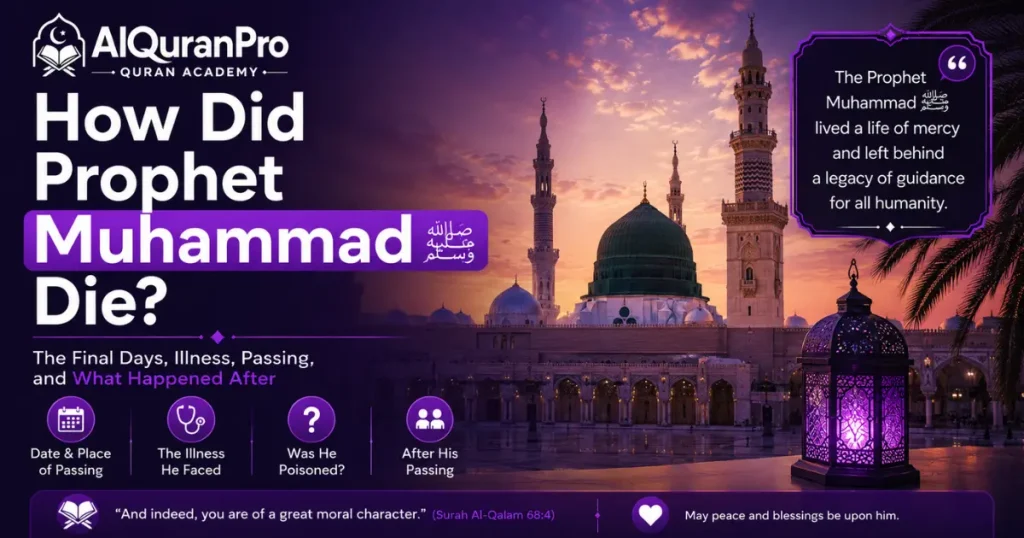
Prophet Muhammad passed away in Medina on the twelfth of Rabi’ al Awwal, 11 AH, which corresponds to 8 June 632 CE. He died after a short but severe illness marked by high fever and intense headaches that lasted for nearly two weeks. He was around 62 or 63 years old at the time, since early biographers do not agree on his exact birth year. Below, you will find a complete and honest look at his final days, the illness that took his life, the ongoing debate about poisoning, and what happened to the Muslim community immediately after his passing.
When and Where Did He Pass Away
Muhammad died in the house of his wife Aisha, located right beside the mosque he had built in Medina. According to Encyclopaedia Britannica, he had just completed the Farewell Pilgrimage to Mecca a few months earlier, in what would turn out to be the final months of his life. That pilgrimage set the pattern that Muslims still follow during Hajj today.
Here is a quick summary before we go deeper into the story:
- Date of death: 8 June 632 CE, 12 Rabi’ al Awwal, 11 AH
- Location: Medina, in the room of his wife Aisha
- Age at death: approximately 62 to 63 years
- Cause: a fever and headache illness lasting about two weeks
- Burial site: Masjid an Nabawi, in the same room where he died
The Farewell Pilgrimage Set the Stage
In March 632, Muhammad led what became known as the Farewell Pilgrimage to Mecca. Standing at Mount Arafat, he delivered a sermon that touched on justice, the rights of women, the sanctity of life and property, and the equality of all believers regardless of race or background. Many historians view this sermon as a summary of everything he had taught over the previous two decades.
It also carried a quiet sense that his mission was drawing to a close, since he told the crowd he did not know if he would meet them again after that year. Not long after returning to Medina, he began attending funerals and visiting the graveyard of Baqi, where he prayed for the deceased. It was shortly after one of these visits that the first signs of illness appeared.
The Onset of His Illness
In the eleventh year after the Hijrah, Muhammad started showing symptoms of sickness. He suffered from a persistent fever and severe headaches, yet he continued leading the five daily prayers for around eleven days despite his weakening condition. If you have ever wondered how Muhammad died, this is really where the story begins: not with a sudden event, but with a gradual illness that his body could not overcome.
His condition worsened over roughly two weeks. He asked his other wives for permission to stay in Aisha’s room during this period, and they agreed. She would often recite verses from the Quran and the supplications he had personally taught her, hoping to bring him some comfort. Anyone exploring Islamic studies courses will find that this period of his life is one of the most closely documented parts of his biography, since his companions recorded almost every detail out of love and respect for him.
His Final Week
About five days before his passing, Muhammad addressed the people and warned them strongly against turning the graves of prophets into places of worship. He wanted his own resting place to remain simple, free from idolization. During this same period, he publicly praised the Ansar, the people of Medina who had welcomed him and his followers after the migration from Mecca, and asked the community to treat them with kindness.
Four days before he died, he tried once more to gather the community and offer final guidance, though weakness made it difficult for him to speak clearly. Historians agree that his instructions touched on removing non believers from the Arabian Peninsula and treating visiting delegations with generosity, though accounts differ slightly on the exact wording. Even in these final days, he continued to emphasize the value of prayer, a theme so central to his teaching that entire prayer lessons are still built around the example he set.
Eventually, his weakness overcame him completely, and he appointed his closest companion, Abu Bakr, to lead the congregational prayers in his place.
Was Prophet Muhammad Poisoned at Khaybar
Any honest answer to how did Muhammad die has to address the Khaybar poisoning incident, since it comes up so often in historical discussions. Years earlier, following the Battle of Khaybar, a Jewish woman named Zaynab bint al Harith prepared a roasted lamb and laced it with poison, reportedly hoping to test whether Muhammad was truly a prophet or simply a claimant to power. According to early biographical accounts, he took a bite, sensed something was wrong, and immediately spat it out, warning the other people present. One companion who swallowed a piece, Bishr ibn al Bara, became seriously ill and died from the effects roughly a year later.
Some sources report that during his final illness, Muhammad remarked to Aisha that he still felt the effects of that poisoned meat, comparing the sensation to something severing his aorta. You can read the original narration in Sahih al Bukhari, where this statement is recorded directly from Aisha.
This has led to genuine disagreement among scholars. A minority view holds that the poison contributed to his death years later and that this makes him a martyr in addition to a prophet. The majority view, however, points out that he lived a full and physically active life for roughly three to four years after the Khaybar incident, taking part in battles, leading prayers, and carrying out normal duties without any lasting decline in health.
Given that timeline, most historians and religious scholars treat the final fever and headache illness as a separate and natural cause of death, while still acknowledging that the earlier poisoning attempt was real and well documented. Neither position denies the facts of what happened at Khaybar. The disagreement is really about how much weight to give a years old injury when explaining a death that followed a clearly described two week illness.
A Day Before He Passed Away
On the day before his death, Muhammad gave away nearly everything he owned. He freed the people he held in servitude, distributed his money to those in need, and gave his weapons to the Muslim community. That evening, Aisha had to borrow oil just to keep a lamp lit in their home, and his armor remained mortgaged to a local merchant for a debt of grain. Even in his final hours, simplicity and generosity defined how he lived.
His Final Day
On the morning of his last Monday, Anas ibn Malik later recalled that Muhammad lifted the curtain of Aisha’s room and looked out at the worshippers as Abu Bakr led the dawn prayer. He was smiling, and for a brief moment the congregation was so overjoyed that Abu Bakr nearly stepped back from the prayer line, thinking Muhammad intended to lead it himself. Instead, Muhammad simply gestured for them to continue and withdrew back into the room.
Later that day, he spoke privately with his daughter Fatimah. Witnesses said he first told her something that made her cry, and then something that made her smile. It was only after his death that she revealed the reason: he had told her he would not survive this illness, and shortly afterward, that she would be the first of his family to join him. Understanding what that promise meant requires some familiarity with the Islamic concept of the afterlife, which is explored in more depth in resources on Jannah in Islam.
He also bid farewell individually to his grandchildren and his wives, spoke of the physical pain he was experiencing, and repeated his concern for how slaves and the vulnerable in the community should be treated. As evening approached, Aisha held him as his condition rapidly declined. He used a small tooth stick to clean his teeth one final time with her help, and his last audible words were expressions of faith and prayer, reaffirming his belief in God until his final breath.
This is the part of the story that answers, in the simplest possible terms, how did Prophet Muhammad died: a peaceful passing at home, surrounded by family, following a documented physical illness rather than any single dramatic event. His final words reflected a lifetime built on what Islamic teaching calls iman, a topic covered more fully in guides on iman in Islam.
How the Companions Reacted
News of his death spread through Medina almost instantly, and the reaction was one of disbelief mixed with grief. Umar ibn al Khattab, one of his closest companions, initially refused to accept that Muhammad had actually died and reportedly threatened anyone who claimed otherwise.
It was Abu Bakr who restored calm. He entered the room, confirmed what had happened, and then addressed the gathered crowd with words that are still quoted today: that whoever worshipped Muhammad should know Muhammad was dead, but whoever worshipped God should know that God remains alive and never dies. He then recited a verse from the Quran reminding the community that all messengers before Muhammad had also passed away, and that his death did not diminish the truth of his message. Readers who want to explore that verse and others related to prophetic history in more depth may find it useful to look into a full Quran translation in English.
The question of succession followed almost immediately. After some discussion among the senior companions, Abu Bakr was chosen and confirmed as the first Caliph, the political and spiritual leader who would guide the growing Muslim community in the absence of its founder.
His Burial at Masjid an Nabawi
Muhammad was buried in the very spot where he passed away, inside Aisha’s room, following the accepted principle that prophets are buried where they die rather than moved elsewhere. His body was washed, wrapped in a simple shroud, and laid to rest without elaborate ceremony, consistent with the modesty he had practiced throughout his life.
Over the following centuries, as the mosque expanded, that room became enclosed within the larger structure of Masjid an Nabawi. The site is now marked by the well known Green Dome, and it remains one of the most visited places in the Islamic world. More architectural and historical background on the burial chamber and the mosque that grew around it is available on Wikipedia’s entry for Al Masjid an Nabawi.
His Lasting Legacy
Muhammad is remembered as the founder of Islam, a role that placed him at the center of one of the most consequential religious and political movements in human history. Within a century of his death, the faith he had taught spread from the Arabian Peninsula across North Africa, the Middle East, and into parts of Europe and Asia. According to Pew Research Center, Islam remains the second largest religion in the world today, with roughly two billion followers.
His life and teachings continue to be studied not only by Muslims but by historians, art scholars, and religious researchers around the world. Institutions such as The Metropolitan Museum of Art maintain detailed educational resources on his life and the artistic traditions that grew out of early Islamic civilization, underlining just how far his influence reached beyond religion alone.
Frequently Asked Questions
How did Prophet Muhammad died?
He died after a fever and headache illness that lasted about two weeks, passing away peacefully in Aisha’s room in Medina in June 632 CE.
How old was he when he died?
Most historical sources place his age at death between 62 and 63 years, since his exact birth year is not precisely documented.
Was he poisoned?
He survived a poisoning attempt years earlier at Khaybar, but most scholars attribute his actual death to the separate illness he experienced in his final weeks rather than to that earlier incident.
Where is he buried?
He is buried inside Masjid an Nabawi in Medina, in the same room where he passed away, now marked by the Green Dome.
Did people spell his name differently when searching for this?
Yes, some people search using older English spellings and ask how did Mohammed die, but the historical answer stays exactly the same regardless of spelling.
Who led the Muslim community after his death?
Abu Bakr, one of his earliest and closest companions, was chosen as the first Caliph shortly after his passing.