
Best Prayer for a Headache: Arabic, Meaning, and How to Recite It
A headache can turn an ordinary day upside down. The light feels too bright, your thoughts feel foggy, and even simple tasks like reading or praying with focus become hard. Before you reach for medicine, or alongside it, there is something worth remembering: the Prophet Muhammad ﷺ taught his companions specific words to say when pain struck, and those words are still available to every one of us today.
If you came here looking for a genuine, Sunnah based prayer for a headache, not a random post copied from another website, this guide walks you through it properly. You will find the Arabic text, the transliteration, the English meaning, and clear steps on how and when to recite it. We will also cover what to say during a migraine, which verses of the Quran are known for healing, and a few practical Sunnah habits that pair well with dua.
What This Kind of Prayer Really Means
A headache dua is a short supplication, usually just a sentence or two, that a Muslim recites while placing a hand on the painful area and asking Allah for relief. It is not a magic formula and it is not meant to replace medical care. Rather, it is an act of worship. You are turning to your Creator in a moment of discomfort instead of only relying on what is in your medicine cabinet.
Islam has always encouraged both. The Prophet ﷺ told a companion, as recorded by Abu Dawud, that Allah did not send down an illness without also sending down its cure, and that people should seek treatment. Dua works alongside that search, not against it.
The Prophetic Dua for Head Pain
The most authentic and widely narrated supplication for any bodily pain, including a headache, comes from Sahih Muslim. A companion named Uthman ibn Abi al As complained to the Prophet ﷺ about a pain he had felt in his body ever since he became Muslim. The Prophet ﷺ gave him a precise method to follow.
Arabic: بِسْمِ اللَّهِ (three times) أَعُوذُ بِاللَّهِ وَقُدْرَتِهِ مِنْ شَرِّ مَا أَجِدُ وَأُحَاذِرُ (seven times)
Transliteration: Bismillah (say three times), then A’udhu billahi wa qudratihi min sharri ma ajidu wa uhadhiru (say seven times)
Meaning: In the name of Allah. I seek refuge in Allah and His power from the evil of what I feel and what I fear.
You can read the full narration directly on Sunnah.com, which is the most trusted online reference for authenticated hadith with their original chains and grading.
How to Recite It Correctly
- Place your right hand gently on the part of your head where the pain is strongest.
- Say Bismillah three times.
- Follow with the longer phrase seven times, keeping your hand in place.
- Repeat the entire process whenever the pain returns, there is no fixed limit on how often you can say it.
If you prefer the dua for headache in english only, here is the full translation once again for quick reference: In the name of Allah, said three times, followed by, I seek refuge in Allah and His power from the evil of what I feel and what I fear, said seven times. That is the complete dua in plain English, no Arabic required to understand its meaning, though reciting the Arabic itself carries its own reward.
A Second Dua for Complete Healing
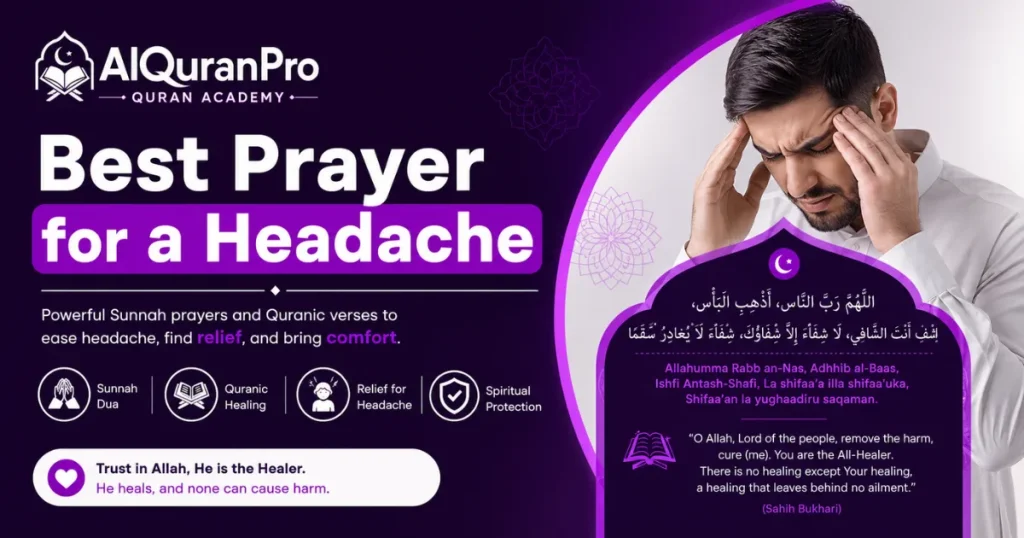
Alongside the pain relief supplication, there is another well known dua that asks Allah directly for a cure. Aisha, the wife of the Prophet ﷺ, narrated that he used to pass his right hand over the site of pain while saying the following.
Arabic: اللَّهُمَّ رَبَّ النَّاسِ أَذْهِبِ الْبَأْسَ اشْفِ أَنْتَ الشَّافِي لَا شِفَاءَ إِلَّا شِفَاؤُكَ شِفَاءً لَا يُغَادِرُ سَقَمًا
Transliteration: Allahumma Rabban nas, adhhibil ba’s, ishfi anta ash Shafi, la shifa’a illa shifa’uka, shifa’an la yughadiru saqama
Meaning: O Allah, Lord of mankind, remove this harm and heal me, You are the Healer, there is no healing except Your healing, a healing that leaves no illness behind.
This hadith is recorded in Sahih al Bukhari, and you can view the original text and chain of narration on Sunnah.com. Scholars note that this dua covers any kind of bodily suffering, so it fits a tension headache just as well as it fits a fever or a stomach ache.
Dua for Migraine and Stronger Pain
Migraines behave differently from an ordinary headache. The pain is often one sided, it throbs, and it can come with nausea or sensitivity to light. According to the Mayo Clinic, migraines are a recognized neurological condition, not simply a stronger version of a normal headache, which is one reason people search for migraine specific guidance separately.
The good news is that the same prophetic supplications above are not limited to mild pain. They were taught as a general response to bodily suffering, so a migraine dua does not need to be a different set of words. What changes is your consistency. During an attack, repeat the pain relief dua slowly and with full attention, placing your hand on the side of your head that hurts. The same migraine pain dua for migraine attacks can be repeated as many times as you need until the intensity eases.
Some people also turn to the story of Prophet Ayyub, known as Job in English, who endured prolonged suffering and called out to Allah in the Quran with these words, found in Surah Al Anbiya.
Arabic: رَبِّ إِنِّي مَسَّنِيَ الضُّرُّ وَأَنتَ أَرْحَمُ الرَّاحِمِينَ
Transliteration: Rabbi inni massaniya ad durru wa anta arhamur rahimin
Meaning: My Lord, indeed adversity has touched me, and You are the Most Merciful of the merciful.
You can read this verse in context on Quran.com. It is short, easy to memorize, and works well for any kind of prolonged discomfort, migraines included.
Ayat Ash Shifa: Quranic Verses Known for Healing
Beyond specific duas, the Quran itself is described by Allah as a source of healing. A well known verse from Surah Al Isra states this plainly, and you can view the full ayah on Quran.com: “And We send down of the Quran that which is a healing and a mercy for the believers.” Muslims often recite this verse, along with a handful of others, collectively known as Ayat ash Shifa, either directly over the area of pain or over a glass of water that is then consumed.
Other commonly recited healing verses include portions of Surah Yunus, Surah An Nahl, Surah Ash Shu’ara, and Surah Fussilat, along with a passage from Surah At Tawbah that speaks of Allah healing the hearts of believers. If you want to study the meaning of these verses more closely rather than only memorizing the Arabic, our guide on the last two ayat of Surah Taubah breaks down the tafsir and lessons of a related passage from the same surah.
How to Perform Ruqyah for a Headache at Home
Ruqyah simply means reciting Quran or authentic duas over yourself or someone else for the purpose of healing. It is a Sunnah practice, not folk medicine, as long as the words used come from the Quran or hadith.
- Perform wudu if you can, and sit somewhere quiet.
- Recite Surah Al Fatiha once, since it is often referred to as the healing surah.
- Follow with Surah Al Ikhlas, Al Falaq, and An Nas, three times each.
- Blow gently into your cupped hands after reciting, then wipe them over your head and face.
- Finish with the pain relief dua from Sahih Muslim, hand on the area that hurts.
- Repeat the full sequence as needed, especially before sleeping or after Fajr.
If your Arabic pronunciation needs work before you attempt ruqyah confidently, structured practice with a qualified tutor makes a real difference, helping you recite each word the way it was taught rather than guessing from a transliteration alone.
Sunnah Remedies to Pair With Dua
Dua is spiritual, but the Prophet ﷺ also recommended physical remedies that many people still use today. Honey, black seed (also called habbatus sawda), and cupping (hijama) are all mentioned in authentic hadith as sources of healing. None of these replace a doctor’s advice for a severe or persistent headache, but they are worth knowing as part of a complete Sunnah approach to health.
If your headaches are frequent, severe, or come with symptoms like blurred vision or numbness, please see a physician. Dua strengthens your reliance on Allah, it does not replace the medical treatment He has also placed on this earth for us to use.
Final Thoughts
This kind of prayer will not always make pain vanish instantly, and that is alright. What it offers is something medicine alone cannot, a moment of sincere connection with Allah in the middle of discomfort. Whether you are reciting the short pain relief supplication, calling on Allah the way Prophet Ayyub did, or reading Ayat ash Shifa over a glass of water, you are practicing exactly what the Prophet ﷺ modeled for us.
If you would like to go deeper into the meanings behind these duas and verses rather than only memorizing them, our Islamic supplication course walks students through the context, grammar, and etiquette of dua in a structured way. You can also explore our Prayer Lesson in Islam course if you want to strengthen the five daily prayers that this kind of dua naturally connects to, or browse our Quran translation course to understand every ayah you recite, not just the ones related to healing. For a broader foundation in Islamic knowledge, our Islamic Studies Online Courses cover topics like this in far more depth. You can also visit our AlQuran Pro Academy to see the full range of one on one Quran classes we offer for kids and adults alike.
Frequently Asked Questions
Is there one single supplication scholars recommend most for head pain?
The pain relief dua from Sahih Muslim 2202 is the most authentically documented and widely recommended by scholars, since it was taught directly by the Prophet ﷺ for bodily pain of any kind.
Can I recite the headache dua in english only, without the Arabic?
Yes, understanding the meaning matters, and reciting in English is perfectly valid. That said, learning the original Arabic wording adds the reward of reciting the Prophet’s own words and deepens your connection to the dua itself.
How many times should I repeat the dua?
Follow the Sunnah pattern of three times for Bismillah and seven times for the longer phrase. Beyond that, there is no fixed limit, you may repeat it as often as the pain requires.
Can I recite this dua for someone else, like a family member with a headache?
Yes. Place your hand on their forehead with their permission and recite the same words on their behalf. This is a recognized form of ruqyah and an act of compassion the Prophet ﷺ himself practiced.
Does reciting dua replace medical treatment?
No. Islam teaches believers to combine spiritual and physical means of healing. See a doctor for anything severe or ongoing, and use dua as a source of comfort and reliance on Allah alongside that care.