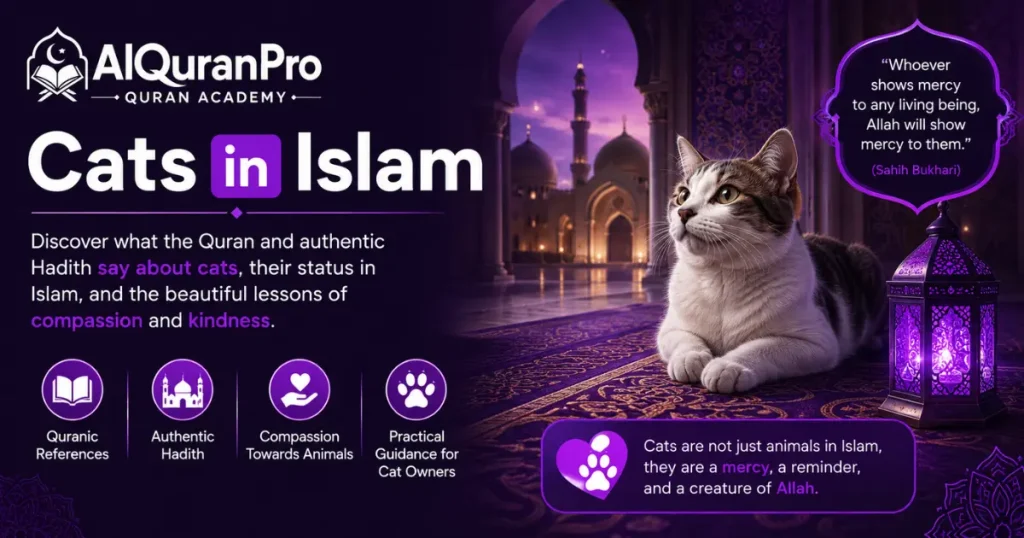
Cats in Islam: What the Quran, Hadith, and Scholars Say
Walk through almost any street in Cairo, Istanbul, or Mecca and you will notice something quickly. Cats are everywhere, and nobody chases them away. They nap outside mosque doors, wander through courtyards, and are fed by strangers who see it as a small act of kindness rather than an inconvenience. That comfort is not an accident of culture. It comes directly from religious teaching, and understanding it gives real insight into how Islam approaches compassion toward animals in general.
This guide walks through what the Quran and the sayings of the Prophet actually say about cats, separates the popular legends from what scholars consider authentic, and answers the practical questions that Muslim cat owners ask most often today.
Why Cats Hold Such a Special Place in the Muslim World
The bond between Islam and cats goes back to the very earliest years of the faith. Unlike dogs, which carry certain restrictions in Islamic law regarding cleanliness, cats are classified as ritually pure animals. That single ruling shaped centuries of everyday life across the Muslim world. It meant cats could roam freely inside homes, sit beside worshippers on prayer mats, and even wander into mosques without anyone treating their presence as a problem.
Historians have traced this affection even further back. Some scholars believe the region’s fondness for cats predates Islam itself and stretches into ancient Egyptian tradition, where cats were treated as sacred protectors of the household. Once Islam spread across Egypt and the wider region, that existing respect for cats blended naturally with the new religious teachings on kindness toward animals.
Are Cats Mentioned in the Quran or Hadith?
The Quran does not name cats directly, but it repeatedly instructs believers to treat all living creatures with mercy. Several verses describe animals as communities in their own right, deserving care rather than cruelty. The specific status of cats comes mainly from hadith, the recorded sayings and actions of the Prophet Muhammad.
One of the clearest rulings comes from a report involving Aisha, the Prophet’s wife. According to the narration, a cat once drank from a container of water and ate a small amount of food, and the Prophet was recorded doing ablution with water a cat had already used. When Aisha was asked about it, she explained that the Messenger of Allah said cats are not impure, since they are simply among the creatures that live closely alongside people in their homes. This report is preserved in Sunan Abi Dawud and is treated as sound by hadith scholars.
That single teaching is the foundation for almost every practical ruling that follows, including whether a Muslim can eat food a cat has touched or pray in clothing a cat has brushed against.
Can Muslims Have Cats?
Yes. Keeping a cat as a pet is permissible in Islam, provided the owner meets a basic obligation: feeding the animal properly and never neglecting or mistreating it. Islamic scholars generally treat cats the same way they treat any other permissible possession that nobody else already owns, meaning a person can take one in and care for it under their own responsibility.
This is not a loosely held opinion. It comes with a firm warning attached. A well known hadith recorded in Sahih al Bukhari describes a woman who locked a cat away without food or water and did not even release it to hunt for its own food, and the Prophet stated that she was punished severely because of this cruelty. The lesson scholars draw from this account is direct: choosing to keep a cat brings responsibility, and failing that responsibility is treated as a serious wrong, not a minor lapse.
For Muslims today, this translates into simple, practical duties. Feed the cat consistently, provide clean water, do not confine it without access to food, and avoid causing it physical harm. Neutering is a point of some scholarly disagreement, though many contemporary scholars permit it when it prevents suffering or an unmanageable population of strays, as long as the procedure itself does not endanger the animal’s life.
If you are exploring how Islam frames obligations like this toward the vulnerable, whether animals, family members, or the wider community, it is worth spending time with a structured Islamic studies course that walks through these rulings with proper context rather than isolated snippets.
Did Prophet Muhammad Have a Cat?
This is one of the most searched questions about the topic, and the honest answer is more nuanced than most articles let on. The famous story involves a cat named Muezza, who is said to have fallen asleep on the sleeve of the Prophet’s robe just as the call to prayer sounded. Rather than disturb her rest, the Prophet is said to have cut off the sleeve and quietly left for prayer, letting the cat continue sleeping undisturbed.
It is a touching image, and it has been repeated for generations across Muslim households and travel writing about the region. However, when scholars trace the story back through the classical hadith collections such as Sahih al Bukhari and Sahih Muslim, the Muezza cat narrative simply does not appear with a verified chain of narration. Hadith specialists classify it as a popular story rather than an authenticated report, which means it likely developed later as a way of illustrating the Prophet’s broader, well documented gentleness toward animals rather than describing a specific, verified event.
What is authenticated, and repeated across multiple reliable hadith collections, is the Prophet’s general instruction to treat cats and other creatures with mercy, along with the ruling that a cat’s presence does not make food, water, or clothing impure. So while the specific tale of the sleeve may be legend, the underlying values it represents are firmly rooted in genuine Islamic teaching, a distinction explored in academic overviews of the tradition as well.
Do Cats Bring Angels in the House in Islam?
This belief circulates widely in Muslim communities, and it is worth addressing honestly. There is no verified hadith stating that cats specifically bring angels into a home. What does exist, and what likely gave rise to this popular idea, is a separate and authentic teaching that angels do not enter a house containing a dog or an image of a living being, paired with the established ruling that cats, unlike dogs, are considered clean.
Over time, that contrast between the two animals appears to have been reshaped into the more appealing idea that cats actively invite angels inside. It is an understandable piece of folklore, born from a real ruling, but Muslims should treat it as a cultural belief rather than a textually supported teaching. The genuine, well documented point is simply this: a cat’s presence in a Muslim home does not interfere with prayer, cleanliness, or spiritual practice the way keeping a dog indoors traditionally has been understood to.
Cats and Dogs in Islamic Law: Why the Difference?
A common point of confusion is why cats and dogs are treated so differently under Islamic rulings, since both are common household animals. The distinction comes down to purity classification. Cats are considered tahir, meaning ritually clean, while a dog’s saliva is classified as najis, meaning ritually impure, which affects how a Muslim must handle prayer and cleanliness after contact.
An early ruling preserved in the Muwatta of Imam Malik describes how a companion named Abu Qatada allowed a cat to drink from his own water container meant for ablution, explaining that cats are not impure because they live in such close proximity to people that avoiding contact with them entirely would be almost impossible. Dogs were not given the same allowance in matters of ritual purity, though Islamic teaching still requires kindness toward them and permits keeping them for guarding property, hunting, or herding.
Interestingly, cats and dogs actually share one category despite this purity distinction: neither is permitted as food, since both fall under animals with fangs that hunt prey, a separate classification from the purity ruling entirely. Researchers studying Islamic history have noted that this dietary restriction exists independently of the purity status, which is why a cat can be considered clean enough to touch your food yet still forbidden to eat.
Everyday Guidance for Muslim Cat Owners
If you already share your home with a cat, or are thinking about adopting one, the practical guidance drawn from these teachings is straightforward.
First, feeding and care are not optional extras. A cat depends entirely on its owner once it is taken in, and neglect carries real religious weight, not just a moral inconvenience. Second, a cat brushing against your clothes or resting near your prayer mat does not invalidate your prayer or require you to change clothing, since the animal itself is ritually clean. This is a reassurance many new Muslim pet owners specifically look for, especially if they are also working on strengthening their daily prayer routine and want to know it will not be disrupted by a pet wandering through the house.
Third, avoid extremes in either direction. Islamic guidance discourages both neglecting an animal and pouring excessive, almost obsessive attention and spending onto a pet while ignoring the needs of people around you. Balance, rather than indulgence, is the theme running through almost every ruling on the subject.
Finally, remember that cruelty toward any animal, including a cat, is treated seriously in Islamic ethics and is discussed alongside other behaviors considered major sins when it involves deliberate harm or neglect. That single point, more than any folk story, is really the heart of what these teachings are trying to instill.
Final Thoughts
The story of cats in this faith is really a story about mercy applied consistently, even to the smallest creatures sharing our homes. Some of the specific tales, like the sleeve of the robe, may be beautiful legend rather than verified history, but the values behind them, cleanliness, compassion, and responsibility toward whatever depends on you, are documented clearly and repeatedly across authentic sources. Whether or not the Prophet personally owned a cat named Muezza, his recorded teachings left no doubt about how animals in general deserve to be treated.
If this topic sparked an interest in learning more about how the Prophet’s daily life and character shaped Islamic teaching more broadly, AlQuranPro Academy offers guided courses covering hadith, seerah, and practical fiqh for learners at every level, along with resources on everyday supplications that reflect this same spirit of gratitude and mercy in daily life.
Quick Answers to Common Questions
Is it haram to kill a cat in Islam?
Deliberately harming or killing a cat without valid cause is strongly condemned and is treated as a sin, based on the hadith regarding the woman who confined her cat until it died.
Can a cat live inside a mosque?
Yes. Since cats are considered ritually clean, their presence inside a mosque is traditionally accepted and is still commonly seen in mosques across the Muslim world today, including the Grand Mosque in Mecca.
Is cat fur or saliva considered impure?
No. Classical rulings, including the report involving Abu Qatada, confirm that a cat’s fur, saliva, and any food or water it touches remain pure.
Can you sell a cat in Islam?
Scholars have differing views here, with some hadith reports discouraging the sale of cats specifically, though many contemporary scholars permit it given how differently pet ownership functions today.