
Prayer Lesson in Islam: A Complete Step by Step Guide to Salah
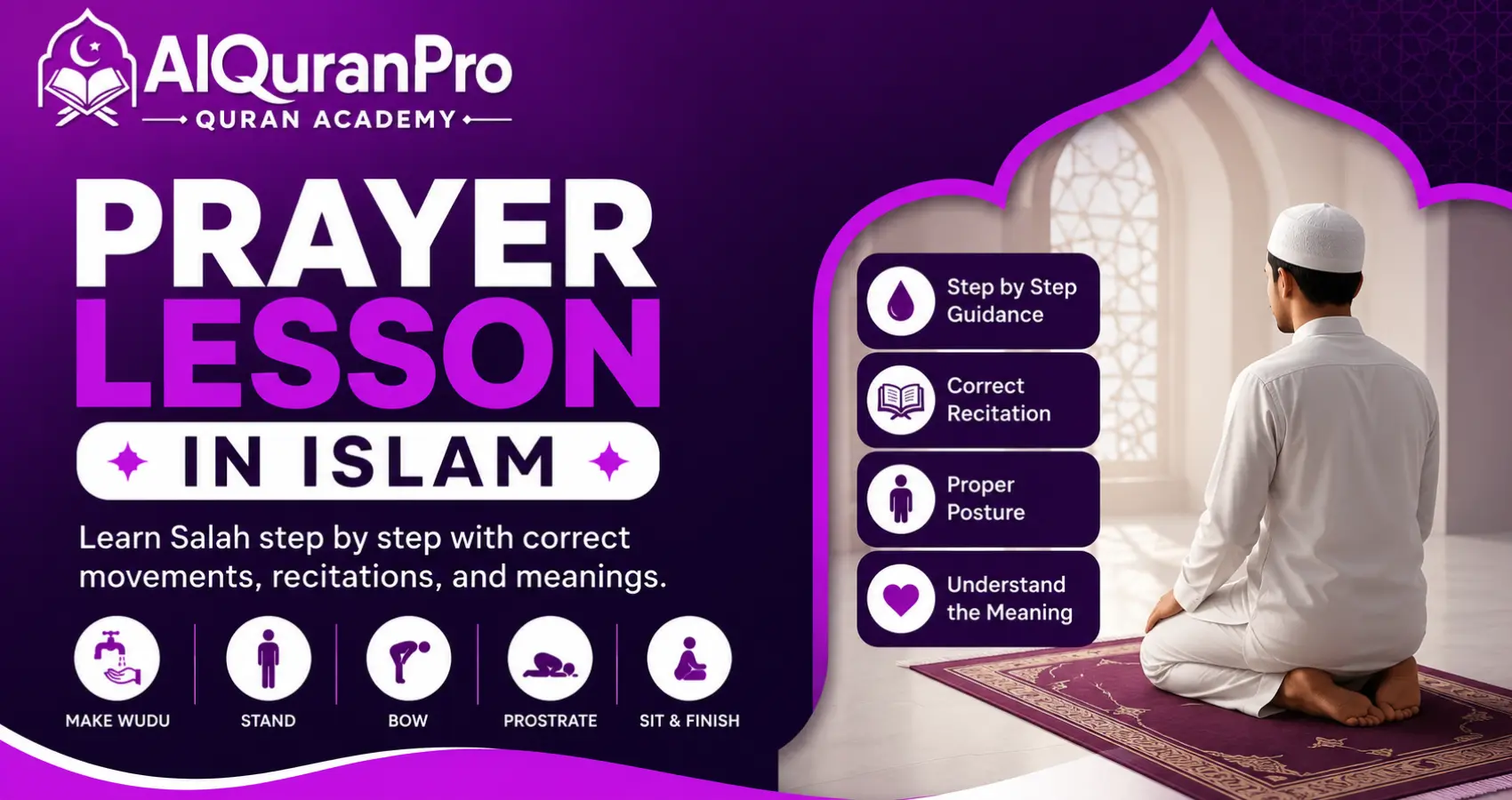
Salah is the second pillar of Islam and the daily act of worship that connects a Muslim directly with Allah. This prayer lesson in Islam walks you through everything from the very first step, making Wudu, all the way to the final greeting that closes the prayer. Whether you are a new Muslim, a parent teaching a child, or simply brushing up on your practice, this guide breaks each movement and recitation into plain, easy steps.
At AlQuran Pro, our teachers guide students of all ages through correct recitation, proper posture, and the meaning behind every word of Salah. This article gives you the same structure our tutors use in class, so you can start practicing with confidence today.
Why Prayer Matters in Islam
Islamic prayer is not a ritual performed out of habit. It is a direct conversation between the worshipper and the Creator, repeated five times a day as a constant reminder of purpose and gratitude. The Prophet Muhammad (peace be upon him) said that Islam is built on five pillars, and prayer is named right after the declaration of faith, showing its central place in a believer’s life. This teaching is recorded in Sahih al Bukhari, one of the most authentic hadith collections referenced by scholars worldwide.
Beyond ritual, prayer shapes character. The Quran explains this clearly in Surah Al Ankabut, where Allah states that establishing prayer keeps a person away from indecency and wrongdoing, since the remembrance of Allah found within it is the greatest reminder of accountability. This is the real purpose behind every rakat you perform, not just movement, but a return to mindfulness five times a day.
How Do Muslims Pray? An Overview of Salah
Salah follows a fixed structure that does not change from one prayer to the next, only the number of units, called rakats, changes depending on the time of day. Each rakat includes standing, recitation, bowing, and two prostrations, performed in a specific order.
If you have ever visited a mosque or watched muslims praying in congregation, you will notice everyone moves together, following the imam through each posture in unison. This unity is one of the most beautiful aspects of congregational salah prayer, though individual prayer at home is equally valid and often necessary for daily life.
According to Britannica, salat is the daily ritual prayer required of all Muslims as one of the five pillars of Islam, and while it can be performed individually in any clean space, collective worship in the mosque carries special merit. This is why you will often see families praying together at home when getting to the mosque is not possible.
Wudu: Preparing for Prayer
Before beginning Salah, a Muslim must be in a state of ritual purity through Wudu, also known as ablution.
The steps of Wudu are as follows.
- Make the intention (Niyyah) to purify yourself for prayer.
- Say Bismillah (In the name of Allah).
- Wash both hands up to the wrists three times.
- Rinse the mouth three times.
- Sniff water into the nostrils and blow it out three times.
- Wash the face from the hairline to the chin, ear to ear, three times.
- Wash both arms up to the elbows three times, starting with the right.
- Wipe the head once with wet hands.
- Wipe the inside and outside of both ears once.
- Wash both feet up to the ankles three times, starting with the right.
Once Wudu is complete, you are ready to begin your prayer in a clean space, facing the Qiblah, the direction of the Kaaba in Makkah.
Full Namaz Steps: From Wudu to Taslim
This section covers the complete sequence of a two rakat prayer, which forms the foundation for every Salah, since additional rakats simply repeat the same pattern.
Step 1: Niyyah (Intention)
Before starting, make a sincere intention in your heart for the specific prayer you are about to offer, such as the two rakats of Fajr. This does not need to be spoken aloud.
Step 2: Takbir (Opening the Prayer)
Raise your hands to your ears and say “Allahu Akbar” (Allah is the Greatest). This phrase marks the formal beginning of the prayer, after which you place your right hand over your left on your chest.
Step 3: Qiyam (Standing and Reciting Al Fatiha)
While standing, recite Surah Al Fatiha, the opening chapter of the Quran.
Alhamdu lillahi Rabbil alameen, Ar Rahmanir Raheem, Maaliki Yawmid Deen, Iyyaka na’budu wa Iyyaka nasta’een, Ihdinas Siraatal Mustaqeem, Siraatal ladheena an’amta alayhim ghayril maghdoobi alayhim wa lad daalleen.
This means: Praise be to Allah, Lord of all the worlds, the Most Gracious, the Most Merciful, Master of the Day of Judgment. You alone we worship, and You alone we ask for help. Guide us to the straight path, the path of those You have blessed, not of those who have earned Your anger, nor of those who have gone astray.
After Al Fatiha, recite a short additional surah such as Al Ikhlas.
Step 4: Ruku (Bowing)
Say “Allahu Akbar” and bow at the waist, placing your hands on your knees with your back straight. Recite three times.
Subhana Rabbiyal Adheem, meaning Glory be to my Lord, the Most Great.
Step 5: Standing from Ruku
Rise back up while saying “Sami Allahu liman hamidah” (Allah hears the one who praises Him), followed by “Rabbana lakal hamd” (Our Lord, all praise is for You).
Step 6: Sujud (Prostration)
Say “Allahu Akbar” and go into prostration, placing your forehead, nose, palms, knees, and toes on the ground. Recite three times.
Subhana Rabbiyal A’la, meaning Glory be to my Lord, the Most High.
Step 7: Sitting Between the Two Prostrations
Rise to a sitting position saying “Allahu Akbar” and recite.
Rabbighfir li, meaning My Lord, forgive me.
Step 8: Second Sujud
Say “Allahu Akbar” and prostrate again, repeating the same tasbeeh recited in the first prostration. This completes one full rakat.
Step 9: Second Rakat
Stand again for the second rakat and repeat steps three through eight, except this time you do not recite the opening thana.
Step 10: Tashahhud
After the second sujud of the second rakat, remain seated and recite Tashahhud silently, followed by Durood Ibrahim, the salutation upon the Prophet Muhammad.
Step 11: Taslim (Ending the Prayer)
Turn your head to the right, saying “Assalamu alaikum wa rahmatullah,” then turn to the left and repeat the same phrase. This completes your Salah.
For prayers with more than two rakats, after Tashahhud in the second rakat, you stand again, say Allahu Akbar, and continue in the same pattern until the final rakat, where Tashahhud, Durood, and Taslim are recited together.
How Many Rakats in Each Prayer
The number of obligatory (Fardh) rakats differs for each of the five daily muslim prayers.
|
Prayer |
Fardh Rakats |
Time of Day |
|
Fajr |
2 |
Before sunrise |
|
Dhuhr |
4 |
After midday |
|
Asr |
4 |
Late afternoon |
|
Maghrib |
3 |
Just after sunset |
|
Isha |
4 |
Night |
Many Muslims also perform Sunnah rakats before or after the Fardh prayer, following the practice of the Prophet Muhammad, though these are recommended rather than obligatory.
Common Mistakes to Avoid in Salah
- Rushing through Ruku and Sujud without settling into the position.
- Forgetting the intention before starting the prayer.
- Reciting Al Fatiha too quickly to be understood.
- Losing focus and letting the mind wander instead of reflecting on the meaning of the words.
- Skipping Wudu or performing it incompletely.
Correcting these small habits early makes a lasting difference in the quality of your worship, and it is exactly what a structured namaz lesson with a qualified tutor helps fix.
How to Pray in Islam for Beginners: Practical Tips
Getting started does not have to feel overwhelming. Start with memorizing Al Fatiha and one short surah, then practice the physical movements slowly until they feel natural. Every new form of islam prayer takes repetition to feel comfortable, so set a reminder for each of the five prayer times, and try praying alongside a family member or teacher who can correct your posture and pronunciation.
Children benefit from the same approach, and parents often find it easier when a tutor introduces the steps in short, structured sessions. Our Quran classes for kids include age appropriate prayer lessons alongside Quran reading, so children learn both the words and their meaning from the start.
Adults who are new to Islam or returning to regular practice can also benefit from a guided course. Our Quran classes for beginners are designed to build both recitation skills and confidence in daily prayer, one step at a time.
Improving Your Recitation and Understanding
Correct pronunciation of Al Fatiha and the surahs you recite in Salah matters, since the meaning and reward are tied to reciting it properly. Our Quran Tajweed course helps students recite each verse with the correct rules of pronunciation, which directly improves the quality of prayer.
If you would like to understand the deeper meaning of the Arabic phrases used throughout Salah, our Arabic language course is a helpful next step. Understanding the language transforms prayer from memorized words into a conversation you truly understand.
For those who want to go further and study the wider teachings of Islam alongside prayer, our Islamic studies courses cover topics such as belief, worship, and daily conduct in more depth.
Students’ Feedback About AlQuran Pro Quran Academy
I would like to thank you for this site which I am now using to get support myself and for my son. May Allah continue to bless you all the team involved in the project.

Alhamdulillah, we are pleased to continue the Quran lessons for my daughter with your Tutor. Please let me know how to renew my bronze package.

My overall experience with Tutor has been very good, Alhamdulillah, and I will definitely be recommending the website to anyone interested. Jazak Allah khair.
Really loving the quick support that you are providing on Alquran Pro. May Allah (SWT) reward you and your team with lots of Khair and Barakah.
Begin Your Journey with AlQuran Pro
This prayer lesson in Islam gives you the complete structure you need, from Wudu to Taslim, but nothing replaces guided practice with a qualified tutor who can correct your pronunciation and posture in real time. AlQuran Pro offers personalized, one on one online classes for children and adults, covering Salah, Quran recitation, and Tajweed with certified male and female teachers.
(No Advance Payment)